Buyer's guide
Best Hot Tubs: Hard-Shell, Plug-and-Play and Portable Picks
 By Petr Hess · Updated November 4, 2026 · 11 min read
We research products from manufacturer specs, independent tests and owner feedback; we have not tested them ourselves. Some links may earn us a commission at no extra cost to you. How we research.
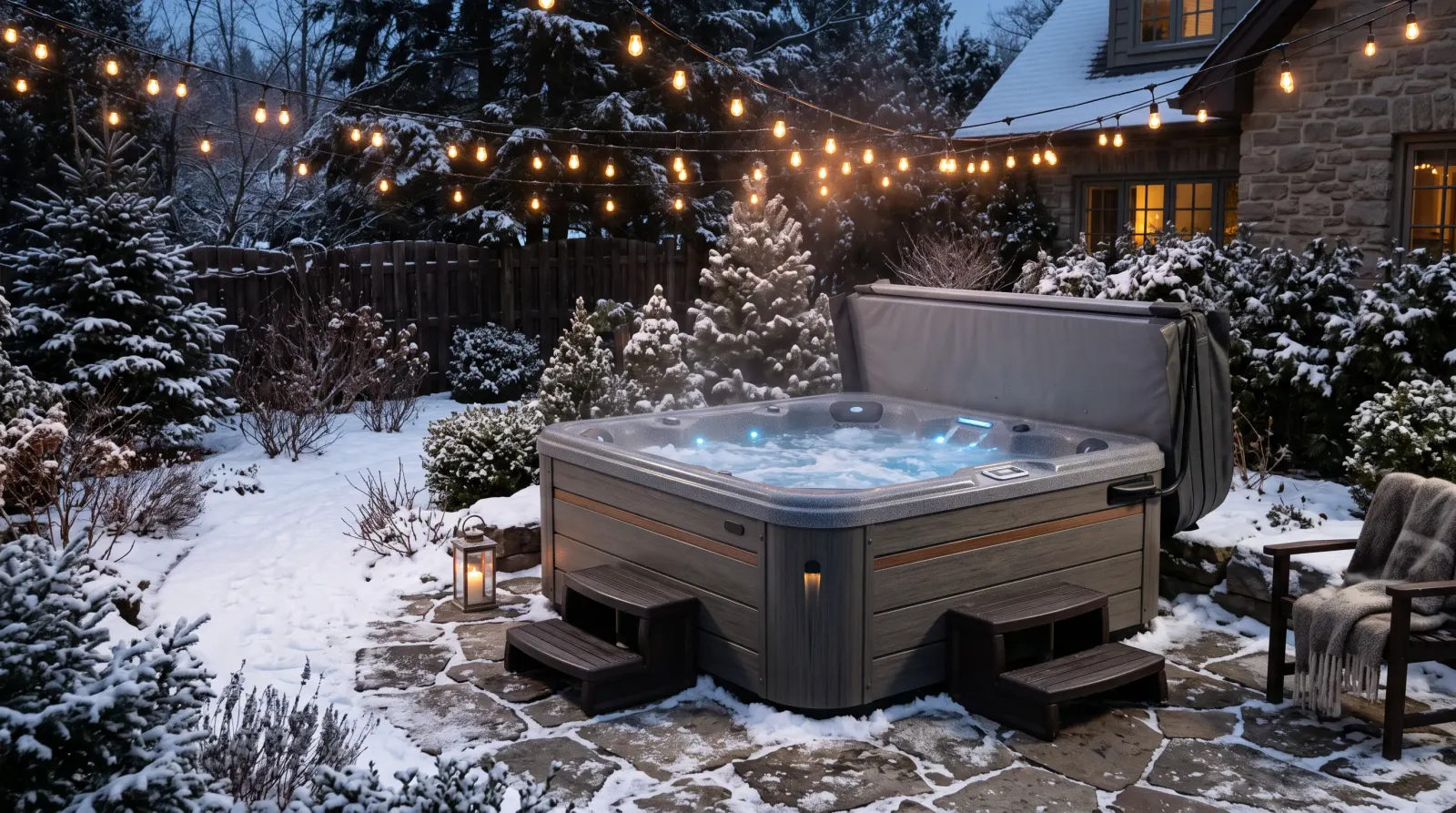
The best hot tubs for most homes are mid-size hard-shell spas with 3 to 5 seats, a full foam or multi-layer insulation package, an insulated tapered cover and a heater you can run on 240V. If you cannot add a 240V circuit, a plug-and-play tub on a 115 to 120V GFCI outlet is the practical route. Inflatables are the budget choice, and they get their own guide.
November is a good time to plan. A tub you order now needs a level base, an electrical run and delivery access before the ground freezes, and Black Friday is close enough that you want your shortlist ready before the sales begin.
This guide is built from manufacturer specification pages and CPSC safety guidance. Plot & Season did not test these tubs. For the basics on types, siting and running costs, start with our hot tub guide.
Our research picks
- Best overallHot Spring Stride3 seats, 20 jets, 225 gal, 115V/20A cord or 230V/50A, FiberCor insulationView at Hot Spring
- Best compact plug-inHot Spring Freeflow Mini2 seats, 11 jets, 125 gal, 115V Plug-N-Play convertible to 230VView at Hot Spring
- Best for familiesJacuzzi J-3856 to 7 seats, 51 jets, 460 gal, 240V at 40 to 60 A, ClearRay ozone plus UV-CView at Jacuzzi
Hot tubs compared
| Model | Type | Best for | Key specs | Main drawback |
|---|---|---|---|---|
| Hot Spring Stride | Hard shell | Couples, small patios | 3 seats; 20 jets; 225 gal (850 L); 115V/20A cord or 230V/50A | 2-year cover on most parts |
| Jacuzzi J-385 | Hard shell | Families | 6 to 7 seats; 51 jets; 460 gal (1,741 L); 240V at 40 to 60 A; ozone plus UV-C | Needs a heavy-duty 240V circuit |
| Hot Spring Grandee | Hard shell | Large households, salt water | 7 seats; 49 jets; 455 gal (1,725 L); 230V/50A; salt system included | 5,810 lb (2,645 kg) filled |
| Hot Spring Freeflow Mini | Hard shell, plug-in | Tight spaces, renters | 2 seats; 11 jets; 125 gal (475 L); 115V Plug-N-Play | Short 1-year plumbing and component cover |
| Softub Legend | Portable foam shell | Moving house, indoor use | 2 to 4 people; 830 L (219 gal); 71 in (180 cm) across; 66 lb (30 kg) tub | Few jets; check local electrics |
How to choose a hot tub
Hard shell, portable or inflatable?
A hard-shell spa has a molded acrylic shell, a cabinet, insulation and a fitted cover. It costs the most up front, holds heat best and lasts longest. A portable foam tub such as Softub sits between the two: light, movable and simple. An inflatable is the cheapest way in. It packs away, but its air walls insulate less than a foam-filled cabinet. Wood-fired tubs are a separate world, with no electrics at all but more work each soak. For the cold half of contrast therapy, see our guide to the best cold plunge tubs.
Electrical supply: 120V or 240V
This decides how fast the tub heats and what installation costs. Hot Spring rates the Stride's heater at 1,000 W on 115V and 4,000 W on 230V. A watt is a unit of power: four times the watts means roughly four times the heat delivered per hour. Larger tubs only come as 240V. Jacuzzi lists the J-385 at 240 VAC with a 40, 50 or 60 amp supply. Hot Spring notes that most tubs need a GFCI circuit breaker and a dedicated circuit, and that electrical work must be done by a licensed electrician.
Insulation and cover
Running cost is mostly heat loss, and heat leaves through the cabinet, the floor and, most of all, the top. Look for full foam or multi-layer foam, a sealed base and a cover with a tapered foam core and a hinge seal. Hot Spring lists a 4 in (10 cm) tapered core cover on the Stride and Freeflow Mini, and an insulated cover on the Grandee. Hot Spring also says the Stride meets California Energy Commission (CEC) and APSP 14 energy standards for portable spas. Ask any brand whether its tub meets them.
Jets, seats and pumps
More jets is not better on its own. Look at seat layout (a lounger suits one tall user; bench seats suit groups), pump horsepower and whether the seats you would actually use have the jets you want. Pump power is in horsepower (HP), a measure of how hard the pump pushes water.
Sanitation
Ozone (an oxidizing gas injected into the water) and UV-C light reduce how much chlorine or bromine you need. Salt systems generate chlorine from dissolved salt. Jacuzzi fits its ClearRay system with ozone plus UV-C as standard on the J-385. Hot Spring includes its FreshWater salt system on the Grandee; on the Stride it is an extra.
Base, weight and access
Water weighs about 8.3 lb per gallon (1 kg per liter). Hot Spring lists filled weights that include water and a 175 lb (79 kg) adult per seat: 1,655 lb (755 kg) for the Freeflow Mini, 2,975 lb (1,350 kg) for the Stride and 5,810 lb (2,645 kg) for the Grandee. You need a flat, level base that carries that weight. A deck needs a structural check. Measure gates and paths for delivery too.
Price tiers
- Budget: inflatables and simple portable tubs.
- Mid-range: compact and 3 to 5 seat hard shells, often with a plug-in option.
- Premium: 6 to 7 seat hard shells with advanced sanitation, more pumps and longer warranties. Dealer pricing varies, so get quotes that include delivery and electrical work.
The best hot tubs
Hot Spring Stride: best overall
Hot Spring lists the Stride at 3 seats including a lounger, 20 jets, 225 gallons (850 L) and 7 ft x 5 ft 5 in x 29 in (213 x 165 x 74 cm). Its control system supports three electrical setups: 115V/20A through a GFCI-protected cord, 115V/30A, or 230V/50A. The 30 amp and 230V modes need a GFCI-protected subpanel. It uses a two-speed 1.5 HP jet pump, a separate circulation pump, no-bypass filtration and FiberCor insulation. It is ready for Hot Spring's salt system, sold separately.
- Verdict: a well-insulated small spa you can start on a plug-in cord and convert to 230V later.
- Best for: couples and small patios.
- Main drawback: 5 years on the structure, but 2 years on the shell surface, cabinet, plumbing, heater and components.
- Skip it if: you regularly soak with four or more people.
Jacuzzi J-385: best for families
Jacuzzi lists the J-385 with 6 to 7 open seats, 51 jets including PowerPro jets and a 460 gallon (1,741 L) water volume. It measures 91 x 91 x 37.5 in (231 x 231 x 95 cm) and weighs 850 lb (386 kg) dry. Two jet pumps are each rated 2.5 HP continuous, with a separate circulation pump. Filtration is a four-stage system with two 60 sq ft filter cartridges, and the ClearRay Active Oxygen system (ozone plus UV-C) is factory fitted. It needs 240 VAC at 40, 50 or 60 amps.
- Verdict: a big, powerful family tub with sanitation built in.
- Best for: households that soak in groups and want less chemical dosing.
- Main drawback: a heavy-duty 240V circuit is mandatory, and the page does not list warranty terms.
- Skip it if: your garden has no room for a 7.6 ft (2.3 m) square footprint plus access space.
Hot Spring Grandee: best premium salt-water tub
The Grandee is Hot Spring's 7-seat flagship. Hot Spring lists 49 jets, 455 gallons (1,725 L), 8 ft 4 in x 7 ft 7 in x 38 in (254 x 231 x 97 cm) and a 4,000 W heater on 230V/50A through a GFCI-protected subpanel. The FreshWater salt system is included, with 325 sq ft of filter area, multi-layer urethane foam and an insulated base pan. The warranty is the longest here: 7 years on structure and shell surface, and 5 years on cabinet, plumbing, heater and components.
- Verdict: top-tier build and warranty for buyers who want salt-water sanitation.
- Best for: large households planning to keep a tub for a decade.
- Main drawback: 5,810 lb (2,645 kg) filled, so the base needs real engineering.
- Skip it if: two of you will use it most nights; you are heating 455 gallons for two.
Hot Spring Freeflow Mini: best compact plug-in
Hot Spring lists the Freeflow Mini at 2 seats (one lounger, one bucket), 11 jets, 125 gallons (475 L) and 6 ft x 4 ft 5 in x 29 in (183 x 135 x 74 cm). It is sold as a 115V Plug-N-Play spa, convertible to 230V, with a 1,000 W heater at 115V or 4,000 W at 230V. Insulation is spray-in full foam with a 4 in tapered cover and bottom seal. It weighs 260 lb (118 kg) dry.
- Verdict: the simplest way into a hard-shell tub without new wiring.
- Best for: small yards, balconies with a structural sign-off, and rental homes.
- Main drawback: 2 years on the cabinet and 1 year on plumbing and components.
- Skip it if: you want strong hydrotherapy; 11 jets is a light massage.
Softub Legend: best portable non-inflatable
Softub makes foam-walled tubs that are light enough to move. Its European spec table lists the Legend at 2 to 4 people, 830 liters (about 219 gallons), 71 in (180 cm) across and 24 in (61 cm) high. The tub itself weighs 30 kg (66 lb), the lid 12 kg (26 lb) and the motor 18 kg (40 lb). That sheet lists a 230V supply and 5 jets. Softub's US site could not be loaded for this guide, so confirm US electrical specs with a dealer before ordering.
- Verdict: a movable tub that is sturdier than an inflatable and simpler than a hard shell.
- Best for: renters, indoor rooms with a suitable floor, and people who move house.
- Main drawback: only 5 jets, so it is a soak rather than a massage.
- Skip it if: jet therapy is the point for you.
Warranties compared
Headline warranty years hide big differences part by part. Here is what Hot Spring lists for its three models in this guide:
| Part | Grandee | Stride | Freeflow Mini |
|---|---|---|---|
| Structure | 7 years | 5 years | 5 years |
| Shell surface | 7 years | 2 years | 5 years |
| Cabinet | 5 years | 2 years | 2 years |
| Plumbing | 5 years | 2 years | 1 year |
| Heater | 5 years | 2 years | Not listed separately |
| Components | 5 years | 2 years | 1 year |
Pumps, heaters and controls are the working parts, so their cover matters as much as the shell's. Ask any dealer whether labor and call-out fees are included.
Running costs: what drives the bill
A hot tub's electricity use comes from the heater, the pumps and, on some models, an always-on circulation pump. You can estimate the heater's share yourself. Watts divided by 1,000 gives kilowatts (kW), and kW multiplied by hours of running gives kilowatt-hours (kWh), the unit on your bill. Hot Spring's Stride heater is rated 1,000 W on 115V, so every hour it runs uses 1 kWh. On 230V the same heater is rated 4,000 W: it uses 4 kWh an hour but runs for a quarter of the time to deliver the same heat.
The heater runs to replace heat that escapes. So the biggest levers are the ones that stop heat leaving:
- Keep the cover on and strapped down whenever the tub is not in use, and replace it when the foam gets waterlogged.
- Choose a tub with full or multi-layer foam and a sealed base.
- Shelter the tub from wind with a fence, hedge or screen.
- Lower the set temperature a few degrees if you will not use the tub for several days.
Siting your hot tub
- Base: a level concrete pad, pavers on a compacted base or an engineered deck rated for the filled weight.
- Access: leave room around the cabinet for service panels and filters, and clearance behind for a cover lifter.
- Drainage: rain and splash water need somewhere to go, and you will drain the tub for cleaning several times a year.
- Distance from the house: close enough for a short winter walk and a short electrical run, far enough that steam and splash do not soak siding.
- Privacy and view: check sightlines from neighbors' upstairs windows before you pour the pad.
Hot tub safety rules
- Keep water at or below 104°F (40°C). CPSC says hot tub water should never exceed 104°F and considers 100°F (38°C) safe for a healthy adult.
- Pregnancy: CPSC warns that soaking above 102°F (39°C) can cause fetal damage in the first three months, and advises a 100°F maximum. Talk to your doctor.
- Children: CPSC suggests special caution for young children. Supervise them and lock the cover when the tub is not in use.
- No alcohol. CPSC warns that drinking in a hot tub can cause drowsiness, unconsciousness and drowning.
- Electrics: use a GFCI-protected supply, never an extension cord, and have a licensed electrician install any new circuit or subpanel. Hot Spring states that electrical work must be done by a licensed electrician. Test the GFCI as your manual directs.
- Winter: do not let a filled tub lose power in a freeze. If you plan to drain it for winter, follow the manufacturer's winterizing steps.
Before you buy: a quick checklist
- Decide on 120V or 240V and get an electrician's quote first.
- Check the base can carry the filled weight, including people.
- Measure the delivery route: gates, steps and turns.
- Compare warranty terms part by part, not just the headline years.
- Price the cover, filters and sanitation for the first two years.
- Plan where steps, a cover lifter and privacy screening will go.
Next step: if a hard shell is beyond your budget this winter, compare jets, salt water and covers in our guide to the best inflatable hot tubs.
Frequently asked questions
What temperature should a hot tub be?
CPSC says hot tub water should never exceed 104°F (40°C) and considers 100°F (38°C) safe for a healthy adult. Pregnant women should stay at or below 100°F, because soaking above 102°F (39°C) can harm a fetus in the first three months.
Can I plug a hot tub into a normal outlet?
Some compact models can. Hot Spring sells its Freeflow Mini as a 115V Plug-N-Play spa, and its Stride runs on a 115V/20A GFCI-protected cord. Larger tubs such as the Jacuzzi J-385 need a 240V supply at 40 to 60 amps, which means a dedicated circuit installed by a licensed electrician.
How much does a hot tub weigh when full?
A lot. Hot Spring lists its 7-seat Grandee at 5,810 lb (2,645 kg) filled with water and seven adults, and its 2-seat Freeflow Mini at 1,655 lb (755 kg). Check that your deck or patio can carry the filled weight before you order.
Is an inflatable hot tub worth it?
For a tight budget or a rental home, yes. Inflatables cost a fraction of a hard shell and pack away, but they insulate less and usually carry shorter warranties; Intex lists a 1-year limited warranty on its PureSpa Slate Gray Octagon. See our guide to the best inflatable hot tubs for the details.
Should I choose 120V or 240V?
120V (sold as 115V by some brands) is cheaper to install but uses a smaller heater. Hot Spring's Stride heater is rated 1,000 W at 115V and 4,000 W at 230V, so the higher voltage heats four times faster. Choose 240V if you live somewhere cold or want to use the tub most of the year.
Sources
- CPSC, CPSC Warns of Hot Tub Temperatures
- Hot Spring, Stride specifications (2026)
- Hot Spring, Grandee specifications (2026)
- Hot Spring, Freeflow Mini specifications (2026)
- Jacuzzi, J-385 hot tub (2026)
- Softub, Models and technical specifications (2026)
- Hot Spring, How to fix a tripped GFCI circuit breaker