Buyer's guide
Best Cold Plunge Tubs: A Research-Based Buyer's Guide
 By Petr Hess · Updated November 4, 2026 · 11 min read
We research products from manufacturer specs, independent tests and owner feedback; we have not tested them ourselves. Some links may earn us a commission at no extra cost to you. How we research.
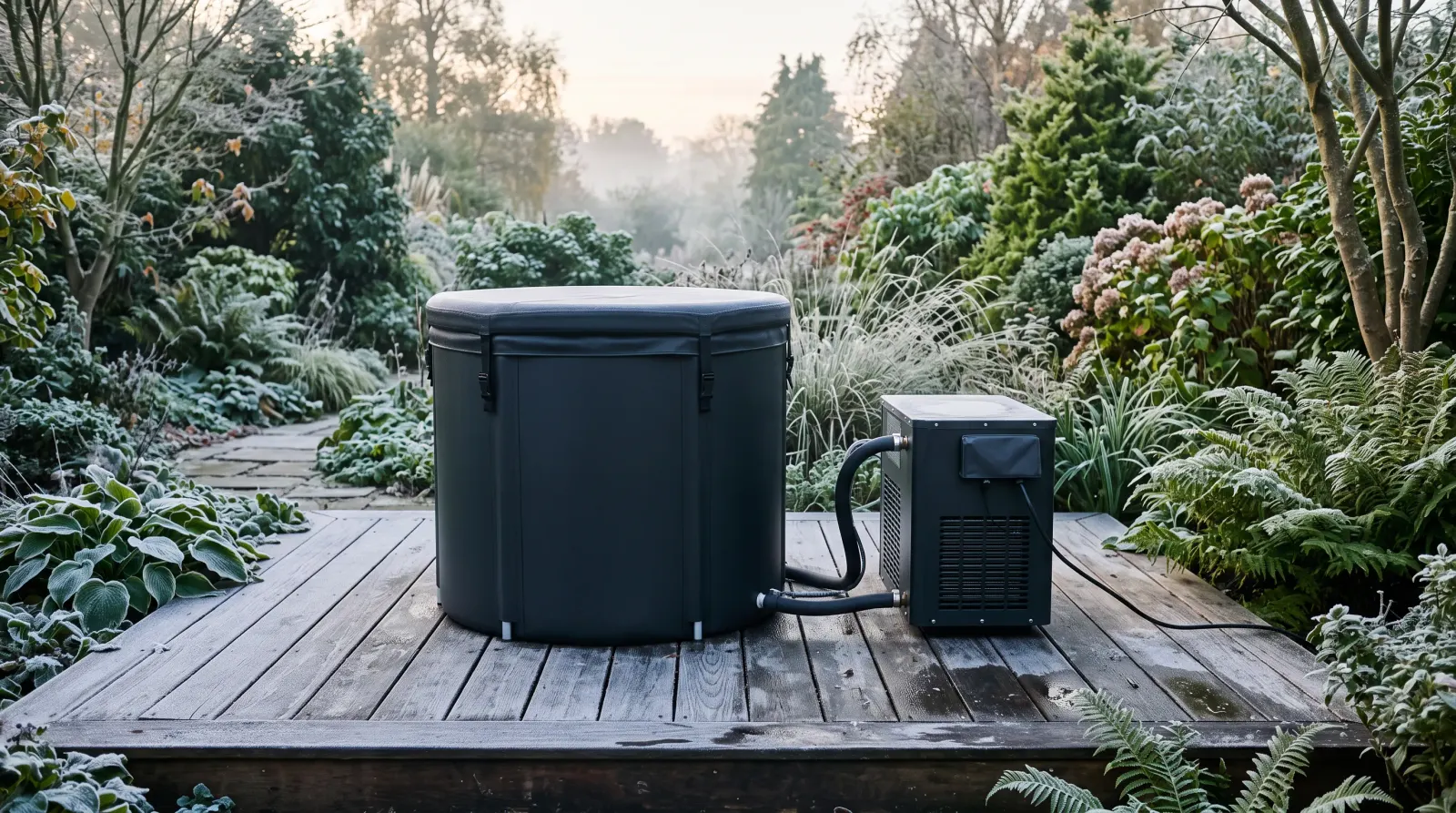
The best cold plunge tubs pair an insulated tub with a chiller, a filter and ozone sanitation, so the water stays at your set temperature for weeks without bags of ice. For most people, a plug-in system that reaches the high 30s °F on a standard 120V circuit is the sweet spot. Spend more only if you want heating as well as cooling, a stainless or aluminum shell that lives outdoors, or a compact upright footprint.
November is when this decision gets real. Water in an uninsulated tub on a deck can freeze, outdoor outlets need sorting before the ground hardens, and Black Friday is close enough that it pays to know which specs you actually need before the sales start.
This guide is built from manufacturer specification pages, one published independent test roundup and health guidance. Nothing here was tested by Plot & Season. If you are still deciding whether cold plunging suits you at all, start with our cold plunge guide.
Our research picks
- Best overallPlunge All-InAbout 105 gal, cools to 37°F, 1 HP chiller, 20-micron filter and ozone, 120V/20AView at Plunge
- Best for small spacesIce Barrel 50057.6 x 30.7 x 42.1 in, fits users up to 6 ft 9 in, built-in chiller ports, 106 lb emptyView at Ice Barrel
- Best for hot and coldRenu Therapy Cold Stoic 3.0Hot and cold from 37 to 104°F, Wi-Fi app control, 5-year limited warrantyView at Renu Therapy
Cold plunge tubs compared
| Model | Best for | Key specs | Main drawback |
|---|---|---|---|
| Plunge All-In | Most people who want plug-in simplicity | About 105 gal; cools to 37°F (3°C); 1 HP chiller; 20-micron filter and ozone; 120V/20A | Needs a 20 amp circuit; 1-year warranty |
| Ice Barrel 500 | Small decks, tall users | 57.6 x 30.7 x 42.1 in; fits users up to 6 ft 9 in; chiller ports; 106 lb (48 kg) empty | Chiller is a separate purchase or bundle |
| Renu Therapy Cold Stoic 3.0 | Contrast therapy in one tub | 37 to 104°F (3 to 40°C); Wi-Fi app; 5-year limited warranty | Heavy and pricey; cramped for tall users in testing |
| Polar Monkeys Cyber Plunge | A stainless tub that lasts | 316 marine-grade stainless steel; about 140 gal; 32 to 107°F (0 to 42°C); 2-year limited warranty | Very expensive; about 1,348 lb (611 kg) filled |
How to choose a cold plunge tub
Chiller power and lowest temperature
The chiller is a small refrigeration unit that pumps water through a heat exchanger. Its size is quoted in horsepower (HP), a rough measure of how fast it can pull heat out. A bigger chiller recovers faster after you get out, and it copes better on a hot day or in a sunny spot. Plunge lists a 1 HP chiller for the All-In and a 1/2 HP unit for The Plunge.
Do not chase the lowest number. Cleveland Clinic advises staying above 40°F (4°C) and suggests beginners start between 50 and 59°F (10 and 15°C). A tub that reaches 37 to 39°F already gives you more range than you should use. Pay more attention to how well the system holds its temperature and how fast it recovers.
Filtration and sanitation
Filtration is rated in microns, a millionth of a meter. A 20-micron filter, which Plunge lists for its tubs and Garage Gym Reviews lists for the Cyber Plunge, catches skin flakes, hair and grit. Ozone is a gas the system injects into the water to oxidize bacteria and organic matter, which cuts down on how often you add chemicals or change water. Some tubs add UV-C light as a second stage. Even with a basic single-stage filter, Garage Gym Reviews reports that the maker of the budget Polar Dive PRO recommends changing the water every three to five days.
Insulation, lid and outdoor rating
Insulation keeps the chiller from running nonstop in summer and helps stop freezing in winter. If a maker quotes an R-value for the walls, higher is better: it measures resistance to heat flow. A tight lid matters as much as the walls. Garage Gym Reviews flagged that the Nordic Wave Viking's lid has no lock, which is a concern with children or pets. For a plunge that lives outside through winter, choose a chiller that can also heat, so it can hold water above freezing.
Power supply
Most plug-in systems run on a 120V household circuit, but amperage differs. Plunge lists 120V/15A for The Plunge and 120V/20A for the All-In. A 20 amp appliance on a 15 amp circuit will trip the breaker. Check your circuit before you buy.
Size, weight and access
Water weighs about 8.3 lb per gallon (1 kg per liter), so a filled tub is heavy. Plunge lists the All-In at about 1,100 lb (499 kg) filled; Ice Barrel lists its 500 at 900 lb (408 kg) full. A deck must be rated for that point load, and an upstairs room needs a structural check. Measure doorways too: Ice Barrel says all its models fit through a standard 31 in (79 cm) door.
Price tiers
- Budget: ice-only inflatables and barrels. Cheap to buy, but you pay in ice and water changes.
- Mid-range: rotomolded or acrylic tubs with a 1/2 to 1 HP chiller, filter and ozone. This is where most home buyers land.
- Premium: stainless steel or insulated aluminum shells, heat-and-chill systems and app control. Renu Therapy's own site listed the Cold Stoic 3.0 from $12,799 in November 2026.
The best cold plunge tubs
Plunge All-In: best overall
Plunge's specifications page lists the All-In at about 105 gallons, with a 1 HP chiller that cools to 37°F (3°C), a 20-micron filter, ozone sanitation and a 120V/20A power requirement. It weighs 270 lb (122 kg) empty and about 1,100 lb (499 kg) filled. A heating option is available. Garage Gym Reviews named Plunge's original tub its best overall and the All-In its best smart cold plunge, praising the minimal setup and indoor or outdoor use.
- Verdict: the most complete plug-in package for people who want to fill it, set it and forget it.
- Best for: a garage, patio or basement with a dedicated 20 amp circuit.
- Main drawback: a 1-year warranty on an expensive appliance.
- Skip it if: your only outlet is on a shared 15 amp circuit and you do not want to pay for a new one.
Ice Barrel 500: best for small spaces
Ice Barrel lists the 500 at 57.6 x 30.7 x 42.1 in (146 x 78 x 107 cm), with built-in stairs, an interior seat and room for most users up to 6 ft 9 in (206 cm). It weighs 106 lb (48 kg) empty and 900 lb (408 kg) full. The barrel has built-in chiller ports, and Ice Barrel sells it with its own chiller as a bundle, listed at $5,749.98 in November 2026. Without the chiller, you are back to buying ice. The brand quotes a limited lifetime warranty and says the system runs under 55 dB (decibels, a measure of loudness).
- Verdict: a sensible choice where floor space is tight or you are tall.
- Best for: small decks, balconies with a structural sign-off, and garages.
- Main drawback: the barrel alone does not chill, so budget for the bundle.
- Skip it if: you want to lie back fully; a long tub suits that better.
Renu Therapy Cold Stoic 3.0: best for hot and cold
Renu Therapy lists the Cold Stoic 3.0 as a hot-and-cold plunge running from 37 to 104°F (3 to 40°C), with Wi-Fi app control and a 5-year limited warranty. Garage Gym Reviews lists it at 95 gallons with a built-in 0.5 HP chiller and heater, dual-stage filtration and ozone. Its testers liked the enclosed chiller and touchscreen, but found it cramped for taller users and hard to climb into. They also noted the weight: 360 lb (163 kg) empty and 1,155 lb (524 kg) filled.
- Verdict: one appliance for cold plunges and warm soaks, with a longer warranty than most.
- Best for: contrast therapy at home when you do not have room for a separate hot tub.
- Main drawback: the price, which started at $12,799 on Renu's site in November 2026.
- Skip it if: you are over 6 ft and want to submerge fully; check the interior length first.
Polar Monkeys Cyber Plunge: best stainless steel tub
Garage Gym Reviews describes the Cyber Plunge as an insulated 316 marine-grade stainless steel lay-down tub with a ChillX chiller, and lists it at 67 x 29 x 24 in (170 x 74 x 61 cm) and about 140 gallons, with a 32 to 107°F (0 to 42°C) range, 20-micron filtration, ozone and a 2-year limited warranty. Its testers liked the hot and cold range, app control and room for taller users. They found the chiller took about two hours to drop the water 10°F, and that it weighs about 180 lb (82 kg) empty and 1,348 lb (611 kg) filled.
- Verdict: a long-life stainless tub with a wide temperature range, at a luxury price.
- Best for: buyers who want metal construction and plan to keep the tub for many years.
- Main drawback: slow cool-down from warm fill water, and a lot of weight on your floor.
- Skip it if: your budget is mid-range; a rotomolded tub with a good chiller does the same job.
What independent testing found
Garage Gym Reviews published a multi-tub roundup based on its own testing, last updated in September 2026. A few of its findings are useful whichever tub you choose:
- Cool-down takes time. Its testers found the Cyber Plunge's chiller took about two hours to drop the water 10°F. Expect a fresh fill from a warm hose to take most of a day to reach plunge temperature.
- Getting in and out matters. Testers marked down the Renu Therapy Cold Stoic 3.0 and the Nordic Wave Viking for being hard to climb into or out of. If you have stiff knees, look for steps, a seat or a low rim.
- Lids need locks. The Viking's lid has no lock, which the testers flagged as a concern with children or pets.
- Specs vary between pages. The roundup itself lists The Plunge at 75, 100 and 105 gallons in different sections. Always confirm the number on the maker's own spec page.
- A chiller for your bathtub exists. Its best indoor pick, the HomePlunge H3, is a wheeled chiller that connects to an ordinary bathtub, chills to 34°F (1°C) and plugs into a standard outlet. Testers noted it can warm up the bathroom.
Running costs and upkeep
A chilled tub costs money to run in three ways: electricity, filters and water.
- Electricity: the chiller draws power whenever it is working to hold temperature. To estimate the cost, multiply the chiller's rated watts by the hours it runs, divide by 1,000 to get kilowatt-hours (kWh), and multiply by your utility rate. A sunny spot, a warm garage or a poor lid all make it run longer. Shade and insulation are the cheapest efficiency upgrades.
- Filters and ozone: filter cartridges need rinsing and periodic replacement. Ask the maker for the replacement interval and the price of a spare before you buy.
- Water: good filtration and ozone stretch the time between water changes. With only a basic filter, the maker of the Polar Dive PRO recommends a change every three to five days, according to Garage Gym Reviews.
Where to put a cold plunge
- Level, strong base: a concrete pad, garage floor or engineered deck that can take the filled weight.
- Shade: direct sun makes the chiller work harder.
- Airflow around the chiller: a chiller moves heat out of the water and into the air around it. Leave the clearance the manual asks for, and expect a small room to warm up.
- A drain route: you will empty it eventually. Know where 100 gallons of water will go.
- Power within reach: the right circuit close enough that you never need an extension cord.
What about budget and inflatable cold plunges?
Inflatable tubs cost a fraction of a chilled system and pack away for winter. Garage Gym Reviews named the Polar Dive PRO its best budget pick and the Sun Home Cold Plunge its best inflatable. The trade-offs are real: thin sidewalls, frequent water changes with only a basic filter, and ice runs if you skip the chiller. If you only plunge a few times a month, an inflatable plus ice is a fair way to find out whether the habit sticks before spending thousands.
Cold plunge safety rules
Cold water immersion is not risk-free. Cleveland Clinic warns that cold water can trigger rapid, uncontrolled breathing (hyperventilation) and can become dangerous quickly. Follow these rules:
- See a doctor first if you have heart disease, high blood pressure, diabetes, peripheral neuropathy, poor circulation or venous stasis, or if you are pregnant. Cleveland Clinic lists all of these.
- Keep it short. Cleveland Clinic says a session should never go longer than five minutes. Beginners should stay in for a minute or two.
- Keep it above 40°F (4°C). Start at 50 to 59°F (10 to 15°C) and use a thermometer to confirm.
- Start slowly. Once or twice a week is enough for beginners.
- Get out if you feel lightheaded or have discomfort beyond the normal sensation of cold.
- Do not plunge alone, after alcohol, or with children unsupervised nearby. Keep the lid closed and secured between sessions.
Electrical safety
Water and mains power need care. Plug your chiller into a GFCI-protected outlet (a ground-fault circuit interrupter cuts the power if current leaks to ground), and follow the manual's circuit rating. Do not run a chiller from an extension cord. If you need a new outdoor outlet, a 20 amp circuit or anything near a hot tub or pool, hire a licensed electrician. Before the first hard frost, check that the cord route and outlet cover are rated for wet locations.
Before you buy: a quick checklist
- Measure the space, the doorway and the route from the delivery truck.
- Check the floor or deck can carry the filled weight.
- Confirm the circuit: voltage, amperage and GFCI protection.
- Decide whether you need heating as well as cooling.
- Check what the warranty covers on the chiller, not just the tub.
- Ask about filter and ozone replacement intervals and costs.
Next step: planning contrast therapy at home? Compare heat options in our guide to the best hot tubs.
Frequently asked questions
How cold should a cold plunge tub be?
Cleveland Clinic advises staying above 40°F (4°C) and suggests beginners start at 50 to 59°F (10 to 15°C). Most chilled tubs can go colder than you need, so a tub that reaches 37 to 39°F already has plenty of range.
Do I need a chiller, or can I use ice?
Ice works for occasional use, but you will be buying and hauling ice for every session and changing water more often. A chiller holds a set temperature around the clock and usually pairs with a filter and ozone, which keeps water usable for longer.
Can a cold plunge tub go outdoors in winter?
Many can, but check the manufacturer's rating. Insulated walls, a locking or tight-fitting lid and a chiller that can also heat (to stop freezing) matter most outdoors. Plan the power run before the ground freezes.
What electrical supply does a cold plunge need?
Most plug-in models run on a standard 120V household circuit, but some need a 20 amp circuit rather than 15 amp. Plunge, for example, lists its All-In at 120V/20A. Use a GFCI-protected outlet and have a licensed electrician add or upgrade the circuit if needed.
How long should I stay in a cold plunge?
Cleveland Clinic says a session should never go longer than five minutes and that beginners should stay in for only a minute or two. Talk to your doctor first if you have heart disease, high blood pressure, diabetes, poor circulation or are pregnant.