How-to
Greenhouse Heating Without Electricity: How to Keep Frost Out
 By Petr Hess · Updated November 4, 2026 · 9 min read
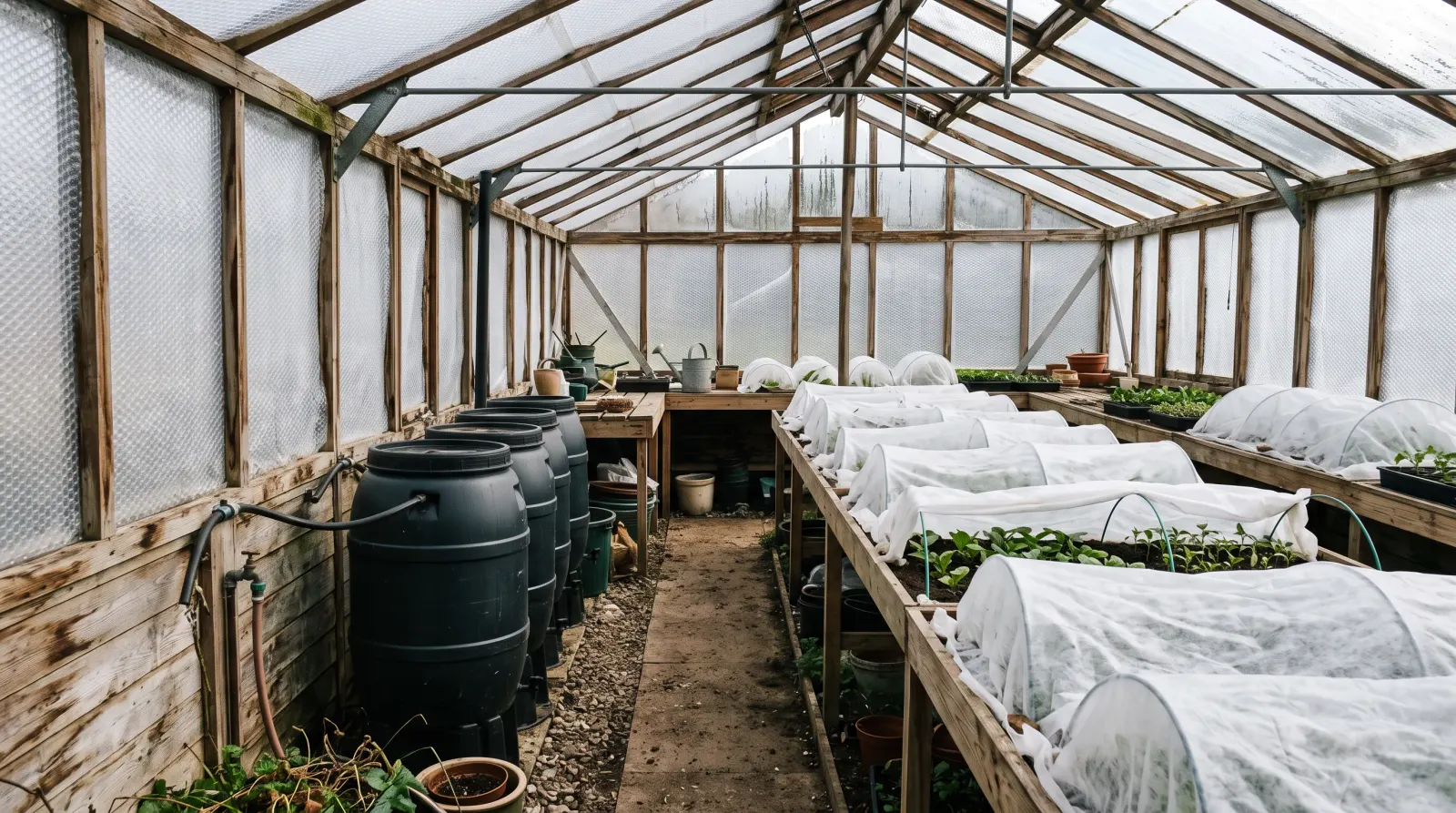
Greenhouse heating without electricity works best as layers. First stop heat escaping by sealing drafts and adding bubble wrap. Then store and trap heat with fleece, thermal mass and hotbeds. Keep a propane or paraffin heater for the coldest nights, used with fresh air.
This guide is part of our greenhouse heating and ventilation section. It is based on RHS advice and extension research from the universities of Georgia, Nebraska and Wisconsin.
Why now: in November the nights lengthen and the first hard frosts arrive across much of the US and UK. Insulation and fleece go up most easily before the coldest weather, while the greenhouse is still dry.
What to expect from non-electric heating
Passive methods buy you degrees, not tropical warmth. The aim for most home growers is frost-free, about 40 °F (4 °C). The RHS says that at that temperature you can overwinter tender plants. An unheated greenhouse can still shelter half-hardy plants over winter and raise young plants in spring.
Before you start, put a max/min thermometer in the middle of the greenhouse near your plants, as the RHS suggests. It records the coldest point each night, so you can see which steps make a difference.
Step 1: Seal drafts and broken panes
The RHS says most heat is lost through drafts and through the structure itself. Sealing is the cheapest heat you will ever buy.
- Replace cracked or missing panes.
- Check that doors and vents close snugly, and renew worn seals.
- Seal cracks with clear silicone. The RHS recommends it because it stays flexible, so panes do not crack when the frame moves.
- Make sure you can still open at least one vent. You need airflow on mild days to prevent damp, mold and gray mold, and you need it if you use a fuel heater.
Step 2: Line the greenhouse with bubble wrap
Horticultural bubble wrap traps a layer of still air against the glass or plastic. The RHS calls it a worthwhile trade-off, with one cost: it cuts light by about 10%.
- Fix it to the inside of the frame, with clips and tape placed so they block as little light as possible.
- For light-hungry crops such as winter lettuce, and for alpines, line the sides and north-facing roof only, or skip it.
- Reuse it next year. The RHS notes there is no transparent alternative at present, and the same sheet can last several seasons.
Step 3: Shrink the space you need to keep warm
If a large greenhouse holds only a few tender plants, the RHS suggests building a screen of bubble wrap on wooden battens to close off a smaller section. Grouping plants together means any heat you add goes further.
Step 4: Cover plants with fleece on cold nights
Horticultural fleece is a light, translucent fabric laid over plants. The RHS says heavier grades give about 2 °C (about 4 °F) of frost protection. Drape it directly over plants on frosty nights, usually without hoops, and lift it during the day so plants get full light and air.
Step 5: Add thermal mass, if it is enough to matter
Thermal mass is anything heavy that soaks up heat from the sun during the day and gives it back at night. Water and sand are the usual choices.
The advice here looks contradictory, but it is not. The RHS says containers of water give off negligible heat as they freeze, and plants may already be damaged by then. That applies to a few jugs or a bucket in an ordinary greenhouse.
Large amounts of mass work when the greenhouse is designed around them. University of Georgia Extension built a passive solar greenhouse with its glazing facing south and a well-insulated north wall: two layers of 1.5-inch rigid foam board, sold as R-10 insulation. (R-value measures resistance to heat flow; higher is better.) One half had a sand wall about 1 ft wide and 6 ft tall. The other had 55-gallon water barrels stacked two high, each weighing over 450 lb full and secured with cables. Both were painted black. The two halves performed the same, and the structure ran warmer in winter than nearby high tunnels. The researchers estimate it can extend the warm-season crop season by at least a month beyond a high tunnel.
What this means for you:
- Thermal mass works best in full sun, painted dark, and placed along the north side so it does not shade plants.
- Insulating the north wall matters as much as the mass. Heat stored at night is wasted if it leaks straight out the back.
- Barrels are heavy. Put them on a firm base and secure stacked ones, as the Georgia team did.
- The same Georgia greenhouse ran nearly 20 °F hotter than the open field in summer, so plan extra ventilation and shading for spring and summer.
Step 6: Build a hotbed or cold frame inside or beside the greenhouse
A hotbed is a bed warmed from below by rotting manure. Nebraska Extension gives this method:
- Dig a pit about 2 ft deep, deeper if your soil drains poorly.
- Add about 18 inches of fresh, straw-filled horse manure.
- Cover it with about 6 inches of good soil and sow or plant into that.
- Add fresh manure each spring and fall to keep the heat coming.
The drawbacks: it must be dug out and replaced each year, it smells, and it gives little temperature control. Nebraska Extension also flags food safety: fresh manure touching edible crops is a concern, though not for ornamentals. Keep a solid layer of soil between the manure and any food crops.
A cold frame, a low box with a clear lid, needs no heat source at all. Nebraska Extension says a cold frame moderates air temperature by about 5 to 10 °F or more, and black water-filled containers inside can store daytime heat. Prop the lid open on warm days so plants do not overheat, and cover plants with removable insulation on the coldest nights.
Step 7: Let the vents run themselves
Once a greenhouse is sealed and insulated, it can overheat on sunny days, and you will not always be there to open a vent. A wax-cylinder vent opener solves this without power. Wax inside the cylinder expands as it warms, pushing the vent open, and the vent closes again as the wax cools.
The Univent opener, for example, needs no electricity or batteries, can be set to start opening between 60 and 77 °F, and lifts up to 15 lb. The retailer notes it suits only top-hinged roof vents that close by gravity, and not high-wind sites.
Step 8: Use a fuel heater as backup, safely
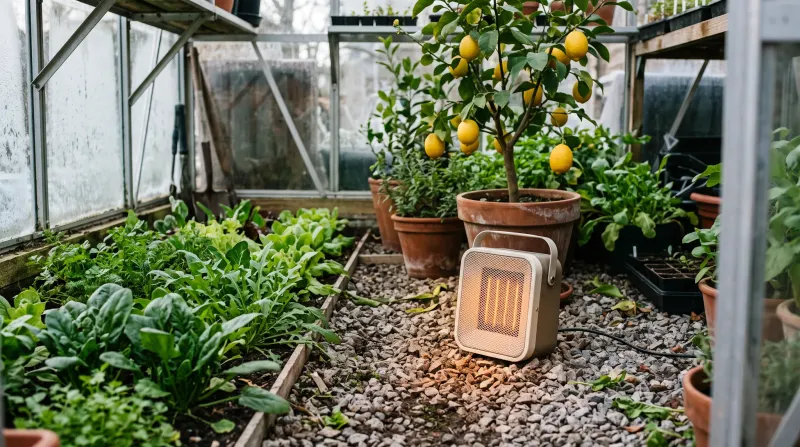
On the coldest nights, passive steps may not be enough. A propane or paraffin heater is the usual answer where there is no power. The RHS says these heaters suit sites such as allotments with no electricity. It adds that the ventilation they need reduces their heating effect, so they suit frost protection for tender and hardier plants.
Two options that need no electricity:
- Mr. Heater Big Buddy: a radiant propane heater with settings of 4,000, 9,000 and 18,000 BTU per hour (British thermal units, the US measure of heat output). Mr. Heater rates it for up to 450 sq ft and lists an oxygen depletion sensor, which shuts it off if oxygen runs low, plus a tip-over shut-off. It has no thermostat, and greenhouses are not on the maker's list of uses. It was around $240 on Mr. Heater's site in November 2026.
- Bio Green Frostbuster 340 W: a small propane heater with a thermal fuse, rated for greenhouses and cold frames up to 3 m² (about 32 sq ft). It has no thermostat. It was around £100 on Bio Green's UK site in November 2026, shown out of stock.
Safety rules for fuel heaters
Burning fuel inside a closed space releases the exhaust into the air you and your plants share. University of Wisconsin Extension lists water vapor, ethylene, sulfur dioxide, nitrous oxide and carbon monoxide among the by-products.
- Give it fresh air every time. The extension guide says portable unvented heaters are not suited to enclosed structures. For emergency or temporary greenhouse heating, it recommends LP gas (propane) units only, with a vent or door open. Its general rule is 1 square inch of inlet opening per 2,000 to 2,500 BTU per hour of heater output. Follow the heater manual first if it says otherwise.
- Know the carbon monoxide symptoms. The NHS lists gas and paraffin heaters as sources of carbon monoxide, which you cannot see or smell. Symptoms include headache, dizziness, nausea, weakness, tiredness, confusion and shortness of breath. If you notice any, turn the heater off, go outside and get medical advice. In an emergency, call 911 in the US or 999 in the UK.
- Never sleep or work for long in a greenhouse with a flame heater running. Do not use one in a greenhouse or conservatory that opens into your home.
- Treat a smell as a warning. The extension guide says the smell of flue gases in a greenhouse means the heaters are not getting enough fresh air.
- Watch your plants. Ethylene damages plants at very low levels, and the effects may not show for one to two weeks. The guide lists tomatoes, cucumbers, lettuce, peppers and bedding plants as susceptible.
- Manage the damp. Burning propane adds about 1.5 lb of water to the air per gallon burned. Vent on mild days to keep fungal disease down.
A simple plan for this winter
- Now: clean the glass for maximum light, as the RHS advises, then seal gaps and fit bubble wrap.
- Before the first hard frost: group tender plants, set up a bubble-wrap partition if the greenhouse is large, and keep fleece within reach.
- On forecast frost nights: fleece the plants. If the max/min thermometer has been getting close to freezing, run a fuel heater with a vent open.
- Late winter: build a hotbed for early sowings, and fit a wax vent opener before sunny spring days arrive.
Next step
If you can get a safe, outdoor-rated power supply to your greenhouse, an electric heater with a thermostat is easier to control and gives off no fumes. Compare models, sizing and safety rules in our guide to the best greenhouse heaters.
Frequently asked questions
How can I keep my greenhouse above freezing without power?
Seal drafts, line the walls with bubble wrap, cover plants with heavy fleece on cold nights, and add a propane or paraffin heater with fresh air for the hardest frosts.
Do water barrels really heat a greenhouse?
A few jugs do very little; the RHS calls the heat they give off negligible. Large amounts of thermal mass do work in a greenhouse designed for it. A University of Georgia passive solar greenhouse used stacked 55-gallon barrels against an insulated north wall.
Is it safe to use a propane heater in a greenhouse?
Only with ventilation. University of Wisconsin Extension recommends LP gas units for emergency greenhouse heating, with a vent or door open to replace the oxygen the heater burns. Do not use one in a greenhouse attached to your house, and leave at once if you feel headachy or dizzy.
How much does bubble wrap help in a greenhouse?
It insulates well enough that the RHS calls it worthwhile, but it cuts light by about 10%. Skip it on the roof for light-hungry crops such as winter lettuce.
Sources
- RHS, How to heat a greenhouse efficiently
- University of Georgia Extension, Constructing a Passive Solar Greenhouse for Season Extension (B1566, 2024)
- Nebraska Extension, Pushing the Limits: Extend Your Growing Season with a Hotbed or Cold Frame (2022)
- University of Wisconsin-Extension, Greenhouse Unit Heaters: Types, Placement and Efficiency (2011)
- NHS, Carbon monoxide poisoning
- RHS, How to make the most of your greenhouse in winter