Buyer's guide
Best Greenhouse Heaters: Electric and Propane Picks, With the Safety Rules
 By Petr Hess · Updated November 4, 2026 · 14 min read
We research products from manufacturer specs, independent tests and owner feedback; we have not tested them ourselves. Some links may earn us a commission at no extra cost to you. How we research.
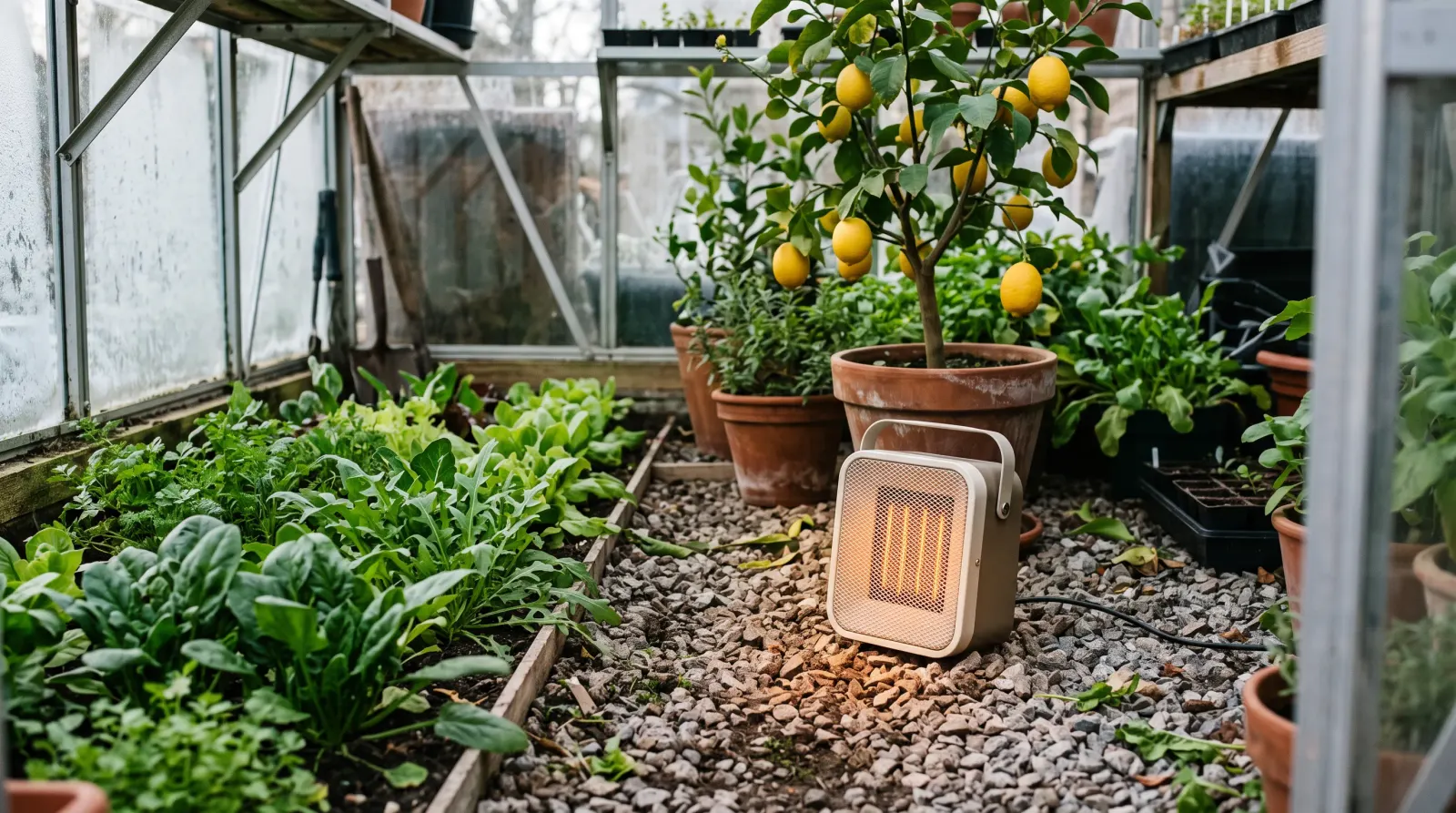
The best greenhouse heaters for most home growers are splash-proof electric fan heaters with a thermostat, such as the Bio Green Palma, because they hold a steady temperature and give off no fumes. If you have no power at the greenhouse, a propane heater with an oxygen depletion sensor is the practical backup, as long as you give it fresh air.
This guide is research-based. It draws on manufacturer specs, an independent test by Bob Vila, and extension guidance on heating and combustion safety. It belongs to our greenhouse heating and ventilation guides.
Why now: the first hard frosts arrive in November across much of the US and UK. Several models below already showed as out of stock on the maker's site in early November 2026. The run-up to Black Friday is a good time to compare prices, but buy on specs first.
Our research picks
- Best overallBio Green Palma2,000 W fan heater (UK version) with Thermo 2 digital thermostat, IPX4 splash-proof, 163 m³/h air circulation, fan-only modeView at Bio Green
- Best budgetBio Green Tropic1,000 / 2,000 W fan heater with frost-monitor function, IPX4, rated for greenhouses up to 12 m²View at Bio Green
- Best for no electricityMr. Heater Big Buddy (MH18B)Radiant propane heater, 4,000 / 9,000 / 18,000 BTU/h, oxygen depletion sensor and tip-over shut-off, up to 450 sq ftView at Mr. Heater
- Best for larger greenhousesBio Green Phoenix1.0 / 1.8 / 2.8 kW fan heater, thermostat 0-26 °C, IPX4 splash-proof, floor-standing or hangingView at Bio Green
Greenhouse heaters compared
| Model | Best for | Key specs | Main drawback |
|---|---|---|---|
| Bio Green Palma | Small greenhouses up to about 130 sq ft (12 m²) | Electric fan; 1,500 W (US) or 2,000 W (UK); digital thermostat; IPX4 | Short power cord |
| Palram-Canopia 1500W Fan Heater | Growers who want strong airflow from a greenhouse maker | Electric fan; 1,500 W; digital thermostat; IPX4; 233 m³/h air output | Listed BTU figure is higher than 1,500 W can produce |
| Bio Green Phoenix | Larger UK greenhouses, up to about 320 sq ft (30 m²) frost-free | Electric fan; 1.0 / 1.8 / 2.8 kW; 32-79 °F (0-26 °C) thermostat; IPX4 | Draws over 12 A on a 13 A UK socket |
| Bio Green Tropic | Budget frost protection, up to about 130 sq ft (12 m²) | Electric fan; 1,000 / 2,000 W; frost-monitor setting; IPX4 | Basic dial control |
| Mr. Heater Big Buddy | Power cuts and greenhouses with no electricity | Propane radiant; 4,000 / 9,000 / 18,000 BTU/h; ODS and tip-over shut-off | No thermostat; needs ventilation |
| Bio Green Frostbuster 340 W | Cold frames and tiny lean-tos | Propane; 340 W; thermal fuse; up to 3 m² (about 32 sq ft) | No thermostat; very low output |
How we chose
We did not test these heaters ourselves. We compared official spec sheets, the heater calculator Bio Green publishes, and Bob Vila's test of nine greenhouse heaters (updated October 2025). That test timed how long each heater took to raise a greenhouse by 30 °F and how well it held the temperature for three hours. Safety guidance comes from University of Wisconsin Extension, the RHS, the CPSC, Electrical Safety First and the NHS. Prices appear only where we saw them on the maker's own site in November 2026.
Two units help when you compare heaters. Watts (W) and kilowatts (kW, 1,000 W) measure electric heat output. BTU per hour (BTU/h, British thermal units) is the usual US rating for fuel heaters. One watt equals about 3.41 BTU/h, so a 1,500 W heater gives about 5,120 BTU/h.
Size the heater before you pick a model
A heater that is too small runs flat out and still loses ground on the coldest night. One that is much too big cycles hard and costs more to buy. Purdue University's greenhouse lab uses a simple formula:
Heat needed (BTU/h) = U-value × surface area (sq ft) × temperature lift (°F)
- Surface area is the total area of the walls and roof covering, not the floor area.
- U-value is how fast heat escapes through the covering. Purdue lists about 1.2 for single-layer polyethylene, 0.70 for double polyethylene and 0.55 for double-wall polycarbonate. Lower is better.
- Temperature lift is your target minus the coldest night you plan for. Keeping 40 °F inside on a 20 °F night is a 20 °F lift.
Worked example: a small twin-wall polycarbonate greenhouse with 300 sq ft of covering, held at 40 °F on a 20 °F night, needs about 0.55 × 300 × 20 = 3,300 BTU/h. Divide by 3.41 and you get roughly 970 W. A 1,500 W heater covers that with some room to spare.
The formula leaves out air leaks, so add a margin. Bio Green's own calculator adds 10% for windy or drafty sites. Insulating with bubble wrap and sealing gaps cuts the number before you buy anything; the RHS says most heat is lost through drafts and the structure.
Set a realistic target, too. The RHS says keeping a greenhouse frost-free at 4 °C (about 40 °F) lets you grow tender plants through winter. Every degree above that costs more to hold.
The best greenhouse heaters
Bio Green Palma: best overall
The Palma is a compact floor-standing fan heater built for greenhouses. Bio Green's UK page lists the current version at 2,000 W with an IPX4 splash-proof rating, 163 m³/h of air circulation (about 96 cubic feet per minute) and a fan-only mode for summer air movement. It ships with the "Thermo 2" digital thermostat, which plugs in between the socket and the heater. The sensor sits on a 9.2 ft (2.8 m) cable, so you can place it at plant height rather than next to the heater. That matters: the RHS notes that a heater's built-in thermostat dial can read a few degrees off because it sits so close to the heat.
In North America the Palma is sold as a 1,500 W, 110-volt model. Bob Vila tested that version and named it best overall. The testers found the digital thermostat easy to use and reported that the heater switched on whenever the temperature dropped below the set point. They list it for spaces up to about 130 sq ft and note an overheat shut-off.
Price: around £200 on Bio Green's UK site in November 2026, where it showed as out of stock.
- Verdict: the safest, simplest way to keep a small greenhouse frost-free.
- Best for: 6 x 8 ft to 8 x 12 ft greenhouses with an outdoor-rated socket.
- Main drawback: Bob Vila's testers found the 6-foot cord short. Bio Green lists 6.2 ft (1.9 m) on the UK model.
- Skip it if: your greenhouse is bigger than about 130 sq ft (12 m²) or you have no power supply.
Palram-Canopia 1500W Greenhouse Fan Heater: best for airflow
Palram-Canopia, which also makes polycarbonate greenhouse kits, sells a 1,500 W fan heater paired with a digital thermostat controller. The official page lists an IPX4 splash-resistant design, a stainless steel heating element, a fan bearing suited to humid air and an auto-reset safety limit that shuts the heater off if it overheats. Palram gives the air output as 233 m³/h (about 137 cubic feet per minute). The European and UK version adds an IP65 external temperature sensor on a 4.9 ft (1.5 m) cable. A 2,400 W version is listed for the EU.
One spec needs care. Palram lists the heater at 8,600 BTU. A 1,500 W electric heater converts to about 5,120 BTU/h, so size your greenhouse on the lower figure. The fan can also run on its own in summer to move humid air.
- Verdict: a well-specified alternative to the Palma, from a greenhouse maker.
- Best for: owners of Palram-Canopia greenhouses and anyone who wants more air movement.
- Main drawback: the BTU claim does not match the wattage, and availability varies by region.
- Skip it if: you need more than 1,500 W from one plug.
Bio Green Phoenix: best for larger greenhouses
The Phoenix is Bio Green's bigger fan heater. The UK model has three output levels (1.0, 1.8 and 2.8 kW), an integrated thermostat that adjusts from 32 to 79 °F (0 to 26 °C), an IPX4 splash-proof rating and a rust-proof steel case. You can stand it on the floor or hang it from the roof with the supplied chain. Bio Green's calculator puts it at up to about 320 sq ft (30 m²) of greenhouse kept frost-free on a 23 °F (-5 °C) night, based on twin-wall polycarbonate.
At full power, 2.8 kW on a 230-volt supply draws about 12 amps. That is close to the 13 A limit of a UK plug, so give it a dedicated socket and do not run it through an extension reel. A US 110-volt version exists, but we could not open an official US product page, so check the rating on any listing.
Price: around £300 on Bio Green's UK site in November 2026 (shown out of stock).
- Verdict: the step up when one Palma is not enough.
- Best for: 8 x 10 ft and larger glass or polycarbonate greenhouses in the UK.
- Main drawback: high current draw at full output, and owner reviews on the maker's page complain about delivery times.
- Skip it if: your supply is a long extension lead or an old outbuilding circuit.
Bio Green Tropic: best budget
The Tropic is a small 1,000 / 2,000 W fan heater with an IPX4 rating, a frost-monitor setting and a stainless steel case. Bio Green rates it for greenhouses up to 12 m² (about 130 sq ft). It is a simpler unit than the Palma: you set it by dial rather than a digital display.
Price: around £100 on Bio Green's UK site in November 2026 (shown out of stock).
- Verdict: enough for frost protection in a small greenhouse at half the Palma's price.
- Best for: keeping a 6 x 8 ft greenhouse above freezing.
- Main drawback: one owner on the maker's page reports the instructions warn against damp environments, which is confusing for a heater sold for greenhouses, and another had a faulty fan replaced.
- Skip it if: you grow tender plants that need a precise temperature. Add a plug-in digital thermostat or choose the Palma.
Mr. Heater Big Buddy: best for no electricity
The Big Buddy (model MH18B) is a radiant propane heater with three settings: 4,000, 9,000 and 18,000 BTU/h. Mr. Heater rates it for enclosed spaces up to 450 sq ft and lists an oxygen depletion sensor (ODS), which shuts the heater off if oxygen runs low, plus a tip-over shut-off. It runs on two 1 lb propane cylinders, or a larger tank with a separate hose and filter. Mr. Heater says it gives up to 11 hours on dual cylinders, is rated to 7,000 ft elevation and carries a 3-year limited warranty. The company also notes that it has removed the fan on some MH18B units because of tariff changes, so check which version you are buying.
Two points matter for greenhouse use. The Big Buddy has no thermostat, so it burns at whatever setting you choose until you turn it down. And Mr. Heater's list of uses covers sheds, barns, garages and workshops but does not mention greenhouses. Read the ventilation section of the manual that comes with your unit before you use it.
Price: around $240 on Mr. Heater's site in November 2026.
- Verdict: a strong emergency heater for power cuts or a greenhouse with no supply.
- Best for: cold-night backup, allotments and off-grid plots.
- Main drawback: adds combustion gases and moisture, and needs fresh air.
- Skip it if: your greenhouse is tightly sealed or attached to your house, or you want hands-off overnight heat.
Bio Green Frostbuster 340 W: best for cold frames
Bio Green's small gas heater, sold as the Frostbuster, burns propane at 340 W (about 1,160 BTU/h). It has a stainless steel case and a thermal fuse, and Bio Green rates it for greenhouses up to 3 m², about 32 sq ft. An 800 W version is also listed. There is no thermostat, so it runs continuously until you shut it off.
Price: around £100 on Bio Green's UK site in November 2026 (shown out of stock).
- Verdict: frost protection for the smallest structures, with no cable to run.
- Best for: cold frames, mini-greenhouses and small lean-tos.
- Main drawback: too little heat for a walk-in greenhouse.
- Skip it if: you have power nearby. A small electric heater is easier to control.
Also worth knowing
- Dr. Infrared Heater DR-218: a 1,500 W, IPX4 greenhouse and workshop heater that Bob Vila named best electric. The testers had to calibrate its thermostat dial with a thermometer. We could not open an official product page, so it has no box here.
- Paraffin heaters: the traditional UK choice for allotments, sold under names such as Bio Green Warmax. They need no power, but read the safety rules below first.
- Household space heaters: Bob Vila included a Vornado room heater but noted it is not splash-proof. In a damp greenhouse, buy a heater rated IPX4 or better.
Electric heater safety
Electric heaters are the cleanest option, but a greenhouse is wet, and water and mains power do not mix. These rules come from the CPSC, Electrical Safety First and the RHS.
- Use a protected, outdoor-rated circuit. In the US, the National Electrical Code has required GFCI protection (ground fault circuit interrupter) on outdoor receptacles since 1973. A GFCI cuts power when current leaks by as little as 0.006 amps. In the UK, use an RCD (residual current device) for all outdoor equipment; if your fusebox does not have one, use a plug-in RCD.
- Get a licensed electrician for permanent wiring. The RHS advises having the greenhouse's electrical connection installed professionally. The CPSC says GFCI circuit breakers and receptacles can be fitted by a qualified electrician, and that you should fit a receptacle GFCI yourself only if you have the skills to wire it correctly.
- Test GFCIs monthly. The CPSC says to test them after installation, at least once a month and after a power cut.
- Do not daisy-chain. A 1,500 W heater draws about 12.5 amps at 120 volts, most of a standard 15-amp circuit. Keep heat mats and grow lights on another circuit if you can. If you must use an extension lead, Electrical Safety First says it must be rated for outdoor use and fully unwound if it is a reel.
- Buy a heater rated IPX4 or higher, keep it off wet floors and away from watering, and keep the plug and socket dry.
Propane and paraffin heater safety: ventilation and carbon monoxide
Any heater that burns fuel inside the greenhouse releases its exhaust into the same air you and your plants breathe. University of Wisconsin Extension lists the by-products as water vapor, ethylene, sulfur dioxide, nitrous oxide and carbon monoxide, and says they can harm plants and people depending on concentration.
- Always give it fresh air. The extension guide says portable unvented heaters are not suited to enclosed structures. For emergency or temporary greenhouse heating, it recommends LP gas (propane) units only, with a vent or door propped open to replace the oxygen burned. Its general rule for inlet openings is 1 square inch per 2,000 to 2,500 BTU/h of heater capacity, but the manufacturer's rule comes first. For an 18,000 BTU/h heater, that general rule works out to about 7 to 9 square inches.
- Know the carbon monoxide signs. The NHS lists gas and paraffin heaters as sources of carbon monoxide, a gas you cannot see or smell. Symptoms include headache, dizziness, nausea, weakness, tiredness, confusion and shortness of breath, and they may ease when you go outside. If you notice them, turn the heater off, get into fresh air and seek medical advice. In an emergency, call 911 in the US or 999 in the UK.
- Do not sleep or linger in a greenhouse with a flame heater running, and do not use one in a greenhouse that opens into your house. Fit a battery CO alarm in any attached structure.
- Watch for plant damage. Ethylene can harm plants at very low levels, and the effects may not show for one to two weeks. The extension guide lists tomatoes, cucumbers, lettuce, peppers and bedding plants as susceptible. Sulfur dioxide causes curled leaves and dead spots.
- Expect condensation. Burning propane adds about 1.5 lb of water to the air per gallon burned, according to the same guide. That raises the risk of fungal disease, so ventilate on mild days.
- Treat a smell as a warning. The extension guide says the smell of flue gases in a greenhouse is a sign the heaters are not getting enough fresh air. Turn the heater off and open up. Follow the maker's instructions on wick care and fuel for paraffin heaters.
The RHS adds that the ventilation gas and paraffin heaters need reduces their heating effect, so they suit tender (H2) and hardier plants rather than warmth-loving ones.
Which type of greenhouse heater should you buy?
- You have power at the greenhouse: choose an electric fan heater with a thermostat. It moves air, which reduces cold corners and mold, and it produces no fumes.
- You have no power, or frequent outages: a propane heater with ODS, used with a vent open, is the best backup. Paraffin is the traditional UK alternative.
- You only need to stop frost in a cold frame: a small gas heater, or better insulation and fleece, may be enough.
Whatever you choose, use a max/min thermometer placed in the middle of the greenhouse near your plants, as the RHS suggests. It shows whether the heater is really holding your target overnight.
Next step
Before you buy a bigger heater, cut the heat you need. Our guide to greenhouse heating without electricity covers insulation, thermal mass, fleece and hotbeds that can lower your heater size and running costs.
Frequently asked questions
What is the safest type of greenhouse heater?
A splash-proof (IPX4) electric fan heater with a thermostat, plugged into a GFCI- or RCD-protected outdoor-rated socket. It produces no combustion gases, so there is no carbon monoxide or ethylene risk to you or your plants.
Can I use a propane heater in a greenhouse?
Only with fresh air. University of Wisconsin Extension says portable unvented heaters are not suited to enclosed structures and, for emergency use, recommends LP gas units only with a vent or door open. Follow the heater manual's ventilation rule, and never sleep or linger in a greenhouse with a flame heater running.
Are paraffin heaters bad for plants?
They can be. Burning fuel adds water vapor, which raises disease risk, and a poorly burning heater gives off gases such as ethylene and sulfur dioxide that damage plants. Keep the wick trimmed, burn clean fuel and ventilate.
What size heater do I need for my greenhouse?
Multiply the covering's surface area (sq ft) by its U-value and by how many degrees you need to lift the temperature. The answer is BTU per hour; divide by 3.41 for watts. Add a margin for wind and leaks.
How warm should I keep a greenhouse in winter?
For frost protection, about 40 °F (4 °C). The RHS says frost-free at 4 °C lets you overwinter tender plants. Warmer settings cost far more to hold.
Sources
- University of Wisconsin-Extension, Greenhouse Unit Heaters: Types, Placement and Efficiency (2011)
- RHS, How to heat a greenhouse efficiently
- Purdue University, Calculating Greenhouse Heating Requirements (2019)
- U.S. Consumer Product Safety Commission, What Is a GFCI? Fact Sheet (2010)
- NHS, Carbon monoxide poisoning
- Electrical Safety First, Garden safety
- Bob Vila, Best Greenhouse Heaters (updated 2025)