Buyer's guide
Best Bird Feeder Cameras: A Research-Based Buyer's Guide
 By Petr Hess · Updated November 4, 2026 · 13 min read
We research products from manufacturer specs, independent tests and owner feedback; we have not tested them ourselves. Some links may earn us a commission at no extra cost to you. How we research.
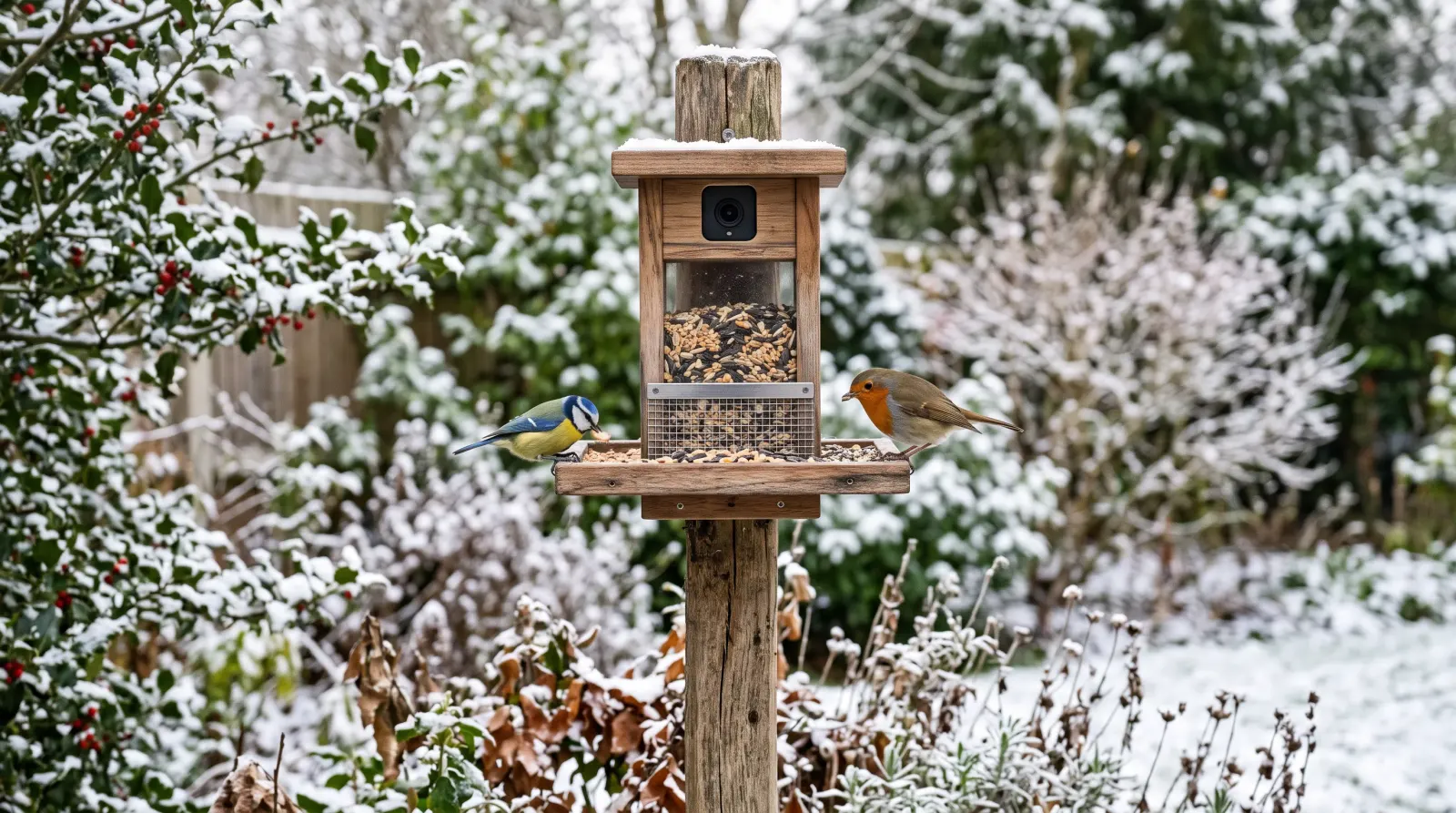
The best bird feeder cameras for most people in 2026 are the Birdbuddy Home, for its large hopper, dual solar panels and 2K video, and the Birdfy Feeder 2 Pro, if you want a dual-lens camera that can be bought with lifetime AI species ID and no ongoing fee. On a tighter budget, the Birdbuddy Nook Solar gives you the same 5 MP (megapixel) photo camera in a smaller feeder.
This guide compares them on the things that decide whether you still enjoy the feeder in six months: subscription terms, solar charging, cold-weather range, Wi-Fi band and how hard the unit is to keep clean. It is built from manufacturer spec sheets and independent reviews, not from our own testing.
Why now: Winter is when a feeder does the most good, as natural food thins out, and a camera lets you watch from indoors on short, cold days. It is also the run-up to Black Friday, when smart feeders often turn up in sales, so it pays to know which model and which plan you want before the sales start.
Our research picks
- Best overallBirdbuddy Home5 MP HDR photos, 2K HDR video, 135° field of view, 6-cup (1.4 L) seed hopper, dual roof solar panels, IP67, 2.4/5 GHz Wi-FiView at Bird Buddy
- Best budgetBirdbuddy Nook Solar5 MP HDR photos, Full HD HDR video with slow motion, 135° field of view, 3.8-cup (0.9 L) hopper, Solar Roof included, IP67, 2.4 GHz Wi-FiView at Bird Buddy
- Best for avoiding a subscriptionBirdfy Feeder 2 ProDual lens (1536×1536 upper, 1920×1080 lower), 9000 mAh battery, 3 W solar panel included, 42.3 oz (2.5 L) food capacity, IP66, 2.4 GHz Wi-Fi, cloud storage onlyView at Birdfy
- Best for side-perching birdsBirdfy Feeder 2 DuoFront dual lens plus 1920×1080 side camera, 9000 mAh battery, 5 W solar panel included, 42.3 oz (2.5 L) food capacity, IP66, 2.4 GHz Wi-FiView at Birdfy
Bird feeder cameras compared
| Model | Best for | Key specs | Main drawback |
|---|---|---|---|
| Birdbuddy Home | Most backyards, families sharing one feeder | 5 MP photos, 2K HDR video, 135° view, 6 cups (1.4 L) seed, dual solar panels, IP67, 2.4/5 GHz Wi-Fi | Automatic species ID for every visitor needs Family Premium |
| Birdbuddy Nook Solar | Small yards, first smart feeder | 5 MP photos, Full HD video, 135° view, 3.8 cups (0.9 L) seed, Solar Roof, IP67, 2.4 GHz | Small hopper needs frequent refills in winter |
| Birdfy Feeder 2 Pro | Close-up portraits without a recurring AI fee | Dual lens, 9000 mAh battery, 3 W solar panel, 42.3 oz (2.5 L) food, IP66, 2.4 GHz | No hanging option; no microSD card |
| Birdfy Feeder 2 Duo | Catching birds that feed from the side | Front dual lens plus side camera, 9000 mAh battery, 5 W solar panel, IP66, 2.4 GHz | Premium tier price; side camera is less sharp |
| Birdbuddy Smart Hummingbird Feeder Pro | Hummingbirds (US only) | 5 MP photos, 2K video, slow motion, 122° view, 14 fl oz nectar, IP67 | Nectar basin needs cleaning at almost every refill |
A few terms used above. MP (megapixels) is still-photo resolution. 2K and Full HD are video resolutions; Full HD is 1920×1080 pixels and 2K is a step above. mAh (milliamp-hours) is battery capacity, so a bigger number means longer between charges for a similar camera. IP66 and IP67 are ingress-protection ratings: both are dust-tight, IP66 resists powerful water jets and IP67 also survives short immersion. W (watts) on a solar panel is its peak output in full sun.
How we chose these picks
We started with the two brands most buyers shortlist, Bird Buddy and Birdfy (made by Netvue), then checked newer rivals. For each model we read the official spec page, the official subscription terms and at least one independent review. We weighed:
- Total cost over three years, not just the box price. A feeder with a paid AI plan can end up costing more than a pricier one with lifetime AI.
- Power. Taking the camera down to charge it is the chore that makes owners give up. Solar and battery size matter more than resolution.
- Weather range. If your winters drop below 14°F (-10°C), the Birdfy Feeder 2 series is outside its listed operating range on the coldest days.
- Wi-Fi. Most feeder cameras use 2.4 GHz only. That band travels further through walls, but some mesh routers need tweaking to accept 2.4 GHz-only devices.
- Squirrels and cleaning. Reviewers rarely complain about megapixels. They complain about squirrels chewing cables and feeders that are hard to wash.
We did not use store star ratings, and we left out prices we could not see on an official page today.
Subscriptions: what is free and what you pay for
This is the single biggest difference between brands, and the terms changed during 2025 and 2026, so read this before comparing camera specs.
Bird Buddy
Bird Buddy's free tier includes photos, videos and the livestream, but species identification is manual. Family Premium adds automatic identification of all visitors, lets you name regular birds and track their visits, and gives Premium access to up to 10 guests. On Bird Buddy's product pages in November 2026, Family Premium was one month free, then around $98.99 a year (about $8.25 a month, billed yearly), cancelable any time. The Hummingbird Feeder Pro page also notes that its top "2K Ultra" video setting needs Premium.
Birdfy
Birdfy sells the Feeder 2 series in two versions: "AI Lifetime Free," which needs no activation or extra payment, and "AI by Subscription," which comes with a 7-day trial and then a monthly, annual or one-time fee. The Feeder 2 FAQ lists free cloud storage with 30-day retention and unlimited sharing with other accounts. Birdfy's newer membership page splits plans into Free, Plus and Pro. It lists unlimited species recognition for videos from your Birdfy devices in the free tier, with "Moment Insight" (automatic species and some sex ID, plus 16 backyard animals) and a Bird Data dashboard for paying members. Plus covers up to two devices; Pro covers up to 10. Because the two pages describe the system differently, confirm which plan your exact version includes at checkout.
MacRumors, reviewing Birdfy units in May 2026, found that the lifetime-AI option added roughly $20 to the price and listed avoiding a subscription as a plus. It did not think the paid Plus plan was worth it given the two-device limit.
The best bird feeder cameras in detail
Birdbuddy Home: best overall
The Birdbuddy Home is Bird Buddy's larger feeder. It shoots 5 MP HDR photos and 2K HDR video through a 135° lens, which is wide enough to see several birds on the perch at once. HDR (high dynamic range) helps in the bright-sky, dark-shadow conditions of a winter morning. The seed hopper holds 6 cups (1.4 L), the most of the Bird Buddy feeders, so you refill less often in a busy week.
Power is the other strength. Two solar panels sit on the roof and feed a 3900 mAh battery, and Bird Buddy says they usually keep it charged, with a USB-C cable as backup. It is the only feeder here with dual-band Wi-Fi (2.4 GHz and 5 GHz), plus Bluetooth (BLE 5.1). The rated operating range is -5°F to 120°F (-20.5°C to 48.5°C), and the camera carries an IP67 rating. Bird Buddy listed it at around $219 in November 2026.
- Verdict: the most complete package for most backyards, and an app MacRumors found more intuitive than Birdfy's.
- Best for: households that want the camera to run for months without being taken down.
- Main drawback: automatic ID of every visitor needs Family Premium, which adds an annual cost.
- Skip it if: you refuse any subscription and want automatic species ID; look at a Birdfy lifetime-AI version instead.
Birdbuddy Nook Solar: best budget
The Nook is Bird Buddy's compact feeder. It keeps the 5 MP HDR photo camera and the 135° lens but records Full HD (1920×1080) video rather than 2K, with a slow-motion mode. The hopper holds 3.8 cups (0.9 L). The Nook Solar version includes the Solar Roof; the battery is the same 3900 mAh unit, rated for up to a month per charge without solar depending on activity. It connects on 2.4 GHz only and is rated IP67.
In November 2026 Bird Buddy listed the Nook Solar at around $159 and the plain Nook at around $99. The solar version is the one to buy: the extra cost buys back the chore of charging. The camera module detaches, so you can bring it inside in extreme weather.
- Verdict: the cheapest sensible route into the Bird Buddy app and its free photo and livestream features.
- Best for: small yards, balconies with a pole or wall mount, and first-time smart feeder owners.
- Main drawback: the small hopper empties fast when a winter flock finds it.
- Skip it if: you feed large numbers of birds daily; the Home holds about 60% more seed.
Birdfy Feeder 2 Pro: best for avoiding a subscription
The Feeder 2 Pro uses two lenses. Per Birdfy's spec sheet, the upper camera records 1536×1536 at 20 fps (frames per second) for tight, square portraits and the lower records 1920×1080 at 20 fps for a wider view, with a high-frame-rate mode for slow motion. It has the biggest battery here at 9000 mAh, a 3 W solar panel in the box and a 42.3 oz (2.5 L) food container. It is rated IP66 and works from 14°F to 113°F (-10°C to 45°C). Wi-Fi is 2.4 GHz only, and there is no microSD slot: footage goes to the cloud.
The main reason to choose it is the "AI Lifetime Free" version, which includes species ID with no ongoing fee. MacRumors' testing of Birdfy feeders found the AI right more often than wrong. In one batch of 47 visits it identified 38, with 14 left unidentified and two misidentified, and it struggled with crows, squirrels and raccoons. The same review flagged a notification for every visit, often more than 50 a day, and no hanging option, so squirrels reach it more easily unless you pole-mount it with a baffle.
- Verdict: the best value over several years if you want automatic ID and buy the lifetime-AI version.
- Best for: close-up portrait shots and buyers who dislike subscriptions.
- Main drawback: no hanging mount and no local storage.
- Skip it if: your winters regularly fall below 14°F (-10°C), or you want to hang the feeder from a branch.
Birdfy Feeder 2 Duo: best for side-perching birds
The Duo adds a side camera (1920×1080 at 20 fps) to the Pro's front dual-lens setup, so it catches birds that cling to the side of the feeder instead of facing the main lens. Both cameras share a 9000 mAh battery system, and the box includes a larger 5 W solar panel. Food capacity, IP66 rating, 2.4 GHz Wi-Fi and temperature range match the Pro. At 3.9 lb (1.75 kg) it is the heaviest unit here, so use a sturdy pole.
MacRumors liked that the Duo picked up birds the single camera missed, but found the portrait lens less crisp than hoped for a premium-tier feeder. In its test, squirrels chewed through a USB-C cable when the feeder was tree-mounted, and the low-sun location needed manual charging twice.
- Verdict: worth it only if a single camera keeps missing your visitors.
- Best for: busy feeders with finches, chickadees and titmice that feed from every angle.
- Main drawback: premium price for a side camera that is less sharp than the main one.
- Skip it if: you mount on a tree, where exposed cables invite squirrels; or if the Pro already covers your perch.
Birdbuddy Smart Hummingbird Feeder Pro: best for hummingbirds
Hummingbirds are fast and small, so this feeder pairs a 1/2.7-inch sensor and a 122° lens with 2K video and a slow-motion mode. It takes 5 MP HDR photos, holds 14 fl oz (1.75 cups) of nectar and runs on a 3800 mAh battery, rated for up to a month per charge depending on use. It is IP67 rated and works from -5°F to 120°F. In November 2026 Bird Buddy listed it at around $249, or around $289 for the Solar version with a Solar Roof. Bird Buddy lists it as available in the US only.
Plan for the cleaning. Cornell's Project FeederWatch advises cleaning hummingbird feeders every couple of days, ideally at every refill, because mold grows quickly in sugar water. Bird Buddy's own page recommends cleaning the basin at least every second refill.
- Verdict: the clear choice if hummingbirds are your main target.
- Best for: US gardens with regular hummingbird traffic in season.
- Main drawback: a nectar feeder is a summer device in most of the US, so it sits idle for months.
- Skip it if: you live outside the US, or you are buying for winter seed-eaters.
On our watch list: Kiwibit Bird Feeder 2 Pro
Kiwibit is the newer brand pushing resolution. Notebookcheck's review of the Bird Feeder 2 Pro (September 2026) lists 4K HDR video, 5 MP stills, phase-detection autofocus, a 130° diagonal view, 1080p at 120 fps in SD-card mode, a detachable 5200 mAh battery with a 5 W solar panel, dual-band Wi-Fi, a 1.7 L hopper and an IP65 rating. It found that AI species recognition is now included permanently, though some cloud features remain paid. The review notes that no mounting pole is included. We could not open Kiwibit's own product pages to confirm the specs, so it is not a full pick yet. It is worth a look if you want local microSD storage, which neither Bird Buddy nor Birdfy offers on these models.
Buying checklist
- Check your Wi-Fi at the feeder spot. Stand where the feeder will go and run a speed test on your phone over 2.4 GHz. Weak signal means dropped livestreams and missed clips.
- Count sun hours. A solar panel needs several hours of direct sun. In December, a north-facing or tree-shaded spot may not keep up.
- Match the temperature range to your winter. Bird Buddy lists -5°F (-20.5°C); Birdfy's Feeder 2 series lists 14°F (-10°C). Below that, bring the camera indoors.
- Price the plan for three years. Add the subscription to the box price. Compare it with a lifetime-AI version.
- Plan the mount. Pole mounts with a baffle stop most squirrels. Keep cables tucked up and out of reach; MacRumors had squirrels chew through a USB-C cable on a tree-mounted feeder.
- Decide on storage. Bird Buddy and Birdfy keep footage in the cloud. If you want files on a card, look at models with a microSD slot.
Placement and care
A camera feeder only works if birds use it and it stays healthy for them. Project FeederWatch suggests a quiet, easy-to-see spot near natural cover such as shrubs, with about 10 ft (3 m) from cover as a compromise that gives birds a refuge while limiting ambushes by cats and squirrels. To reduce window strikes, it recommends marking the outside of nearby windows with patterns spaced no more than 2 in (5 cm) apart.
For hygiene, FeederWatch advises cleaning seed feeders every week or two, more often in heavy use or wet weather. Take the feeder apart, scrub it with warm soapy water, rinse it and let it dry fully. To disinfect, soak parts for 10 minutes in one part bleach to nine parts water, then rinse and dry. Remove the camera module before you wash anything; even IP67 units are not designed to be soaked in bleach. Wear gloves, and wash your hands afterward.
If you see birds with fluffed feathers, crusty eyes or lethargy, clean and disinfect more often. FeederWatch notes that taking feeders down only helps where feeders are scarce; in neighborhoods with many feeders it can crowd birds onto the remaining ones.
Which one should you buy?
- You want the easiest, longest-running setup: Birdbuddy Home, and budget for Family Premium if you want automatic ID.
- You want to spend as little as possible up front: Birdbuddy Nook Solar.
- You never want a monthly bill: Birdfy Feeder 2 Pro in its lifetime-AI version.
- Your feeder is crowded and birds feed from every side: Birdfy Feeder 2 Duo.
- Hummingbirds are the point: Birdbuddy Smart Hummingbird Feeder Pro, solar version.
If you are waiting for a Black Friday price, decide on the exact version first. With Birdfy in particular, the subscription and lifetime-AI versions look almost identical on a product listing, and the cheaper one can cost more over time.
Next step: before you order, read our bird feeder camera guide for mounting, squirrel baffles and how to set up alerts so your phone does not buzz 50 times a day.
Frequently asked questions
Do bird feeder cameras need a subscription?
No, but the free tier varies. Bird Buddy's free tier includes photos, videos and livestream with manual identification; automatic ID of every visitor needs Family Premium. Birdfy sells lifetime-AI versions and also lists species recognition in its free membership tier, so check the exact model and plan before you buy.
Do bird feeder cameras work in winter?
Most do within their rated range. Bird Buddy lists -5°F to 120°F (-20.5°C to 48.5°C) and Birdfy lists 14°F to 113°F (-10°C to 45°C) for the Feeder 2 series. Short winter days also mean less solar charging, so expect to top up the battery by USB-C now and then.
Is a solar roof worth it on a bird feeder camera?
Usually, yes. A solar panel saves you taking the camera down to charge it, which is the most common chore owners mention. It only works well if the panel gets several hours of direct sun, so a shady feeder will still need manual charging.
Can a bird feeder camera use 5 GHz Wi-Fi?
Only some can. The Birdbuddy Home supports 2.4 GHz and 5 GHz; the Birdbuddy Nook and the Birdfy Feeder 2 series connect on 2.4 GHz only. 2.4 GHz has longer range, which helps when the feeder is far from your router.
How often should I clean a camera bird feeder?
Cornell's Project FeederWatch recommends cleaning seed feeders every week or two, more often in wet weather or heavy use, and hummingbird feeders every couple of days, ideally at every refill. Remove the camera module first if the feeder design allows it.
Sources
- Bird Buddy, Birdbuddy Home product page (2026)
- Bird Buddy, Birdbuddy Nook Solar product page (2026)
- Birdfy, Feeder 2 Series Specifications (2026)
- Birdfy, Feeder 2 Series FAQ (2026)
- Birdfy, Birdfy Membership help page (2026)
- MacRumors, Birdfy Bird Bath Pro, Birdfy Feeder, and Birdfy Feeder 2 Duo Review (2026)
- Notebookcheck, Kiwibit Bird Feeder 2 Pro review (2026)
- Cornell Lab Project FeederWatch, Feeding Birds (2026)