Buyer's guide
Best Indoor Gardens for Herbs and Greens: Countertop and Tower Systems
 By Petr Hess · Updated November 4, 2026 · 14 min read
We research products from manufacturer specs, independent tests and owner feedback; we have not tested them ourselves. Some links may earn us a commission at no extra cost to you. How we research.
The best indoor gardens for most homes are a small countertop unit for herbs, such as the Click & Grow Smart Garden 9 or an AeroGarden Harvest, or a vertical hydroponic tower such as the Gardyn Home 4 if you want salad greens every week. Choose by how much you will actually eat, how much floor or counter space you have, and how much ongoing pod and electricity cost you will accept.
This guide compares nine systems from five brands using manufacturer specs, published independent tests and owner reports. It does not rank them on personal testing.
Why now: November is when outdoor herbs die back in most of the US and UK, and it is also the run-up to Black Friday, when these systems are often discounted. Buy on specs, not on the size of the markdown.
Our research picks
- Best overallGardyn Home 430 plants in 24 x 12 x 64 in, 2 x 40W LED, est. 47 kWh/month, 4+ gal tank, two 5MP plant camerasView at Gardyn
- Best budgetAeroGarden Harvest6 pods, 20W LED, up to 12 in grow height, 10.5 x 6 x 17.4 inView at AeroGarden (Scotts Miracle-Gro)
- Best low-maintenance countertopClick & Grow Smart Garden 99 pods, 13W LED, 6.2 kWh/month, 4 L (1.06 gal) wick-fed tank lasts up to 3 weeks, no pumpView at Click & Grow
- Best expandable systemRise Garden 3Floor-standing, 1 to 3 levels, 16 to 108 plants, full-spectrum LEDs, Wi-Fi appView at Rise Gardens
Comparison table
| Model | Best for | Key specs (official) | Main drawback |
|---|---|---|---|
| Gardyn Home 4 | Families who want greens weekly | 30 plants, 2 x 40W LED, est. 47 kWh/month, 4+ gal tank, 2 sq ft footprint | Premium price, best features tied to a paid membership |
| Gardyn Studio 2 | Apartments, 1 to 2 people | 16 plants, one 52W LED, about 26 kWh/month, 1.4 sq ft footprint | Membership upsell; still a floor unit |
| Rise Garden 3 | Serious growers who want to expand | 1 to 3 levels, 16 to 108 plants, Wi-Fi | Among the most expensive here |
| Personal Rise Garden | Countertop hydroponics with an app | 8 pods, 30W LED, 18 in high, 12 lb | Nutrients added by hand |
| Lettuce Grow Farmstand | Large harvests indoors or outdoors | 18 to 36 plants; Nook version 20 plants indoors | Tall and heavy to move when full |
| Click & Grow Smart Garden 9 | Low-effort herbs | 9 pods, 13W, 6.2 kWh/month, 4 L (1.06 gal) tank, no pump | Proprietary pods only |
| Click & Grow Smart Garden 3 | Narrow windowsills and desks | 3 pods, 8W, 3.8 kWh/month, 12 in wide | Very small harvest |
| AeroGarden Harvest | First-time buyers on a budget | 6 pods, 20W LED, 12 in grow height | Owner reviews report patchy germination |
| AeroGarden Bounty | Taller herbs and cherry tomatoes on a counter | 9 pods, 40W LED, 24 in grow height, Wi-Fi | Large for a countertop |
How we chose and what the numbers mean
Every spec here comes from the official product page, opened in November 2026. Where a brand did not publish a figure, such as tank size for some models, we left it out rather than guess. Independent test notes come from Bob Vila's indoor garden tests and its Lettuce Grow review. Owner complaints come from reviews shown on the brands' own product pages.
A few terms you will see:
- W (watts) is how much power the LED grow light draws while it is on. More watts generally means more light, which matters for leafy crops and fruiting plants.
- kWh (kilowatt-hours) is energy used over time. One kWh is 1,000 watts running for one hour. Your power bill charges per kWh, so a garden rated at 26 kWh a month costs 26 times your rate.
- Hydroponic means roots sit in water with dissolved nutrients rather than soil. A pump usually moves the water. Wick-fed systems like Click & Grow draw water up into a growing medium with no pump.
- Grow pods are pre-seeded plugs of growing medium. Most brands sell their own, and some systems only accept their own pods.
Countertop gardens vs vertical towers
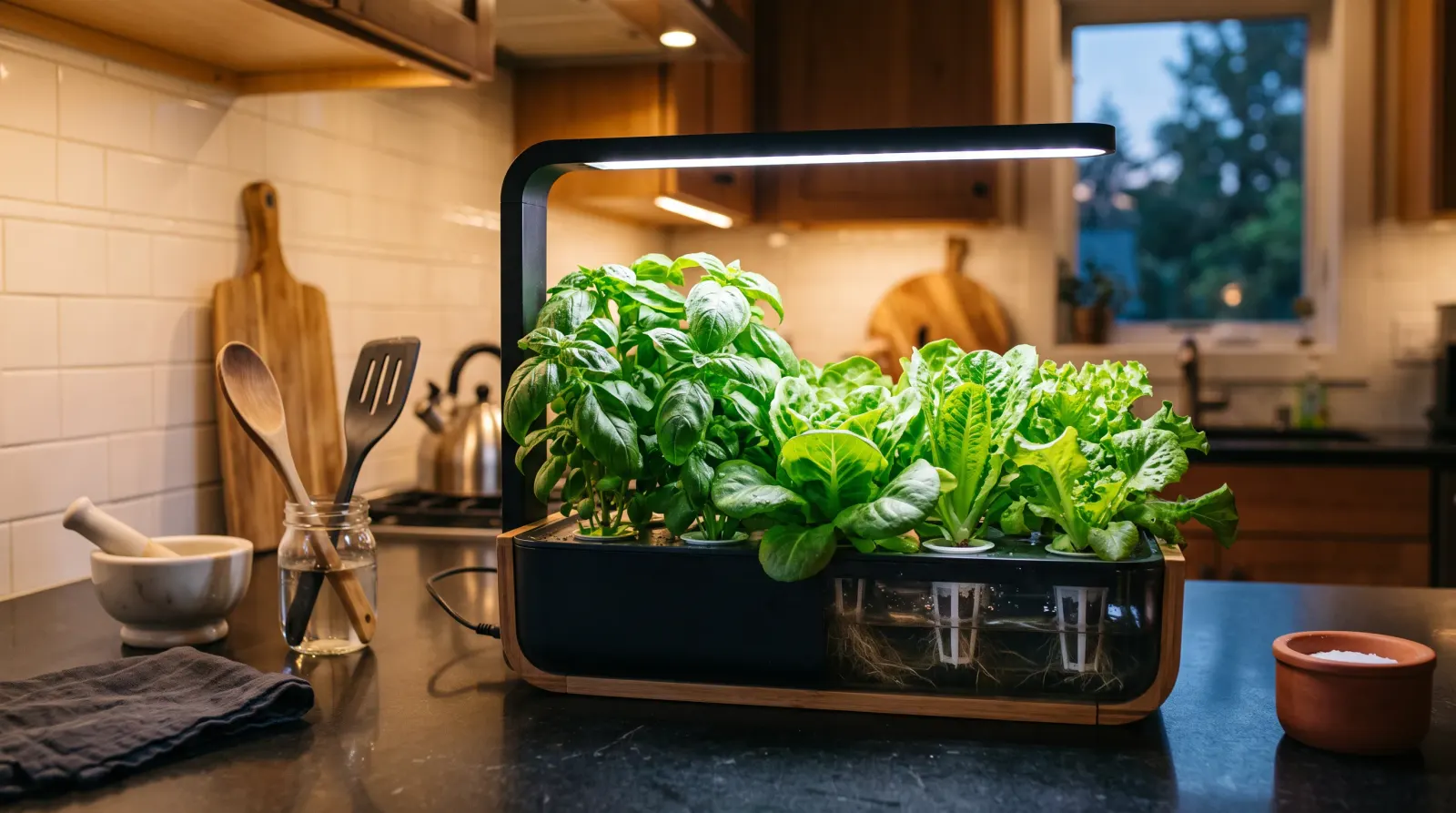
Countertop gardens hold 3 to 9 plants under a light on an arm or a hood. They suit herbs, a few lettuces and, in taller models, compact tomatoes or peppers. They use little power and take up about the space of a bread bin.
Vertical towers stand on the floor and hold 16 to more than 100 plants in stacked columns, with LEDs on bars or rings. They can supply salad for a household, but they cost several times more, use more electricity and need a few minutes of care each week plus a periodic full clean.
The deciding question is volume. If you mostly want basil, parsley and mint for cooking, a countertop unit will likely keep up. If you want to stop buying bagged lettuce, look at a tower.
Gardyn Home 4: best overall for high yield
Gardyn's full-size tower grows up to 30 plants in a footprint of 24 x 12 inches (61 x 30 cm), standing 64 inches (163 cm) tall. Gardyn lists two 40W LED light bars, an estimated 47 kWh a month of energy use, and a tank of 4+ gallons (about 15 L) that it says needs refilling every one to two weeks. Two inward-facing 5MP cameras photograph the plants every 30 minutes so the app's assistant, Kelby, can flag problems and adjust light and water schedules. Gardyn states the cameras face only the plants, record no audio, and can be switched off in the app.
The unit runs on 110V to 240V, needs a grounded outlet and a 2.4GHz Wi-Fi network (5GHz is not supported), and is rated for rooms between 50°F and 95°F (10°C to 35°C). Gardyn includes a 3-year warranty and a free 30-plant starter set.
Membership is optional. Gardyn's FAQ says the 30-day free trial includes 10 monthly plant credits, free shipping, 60% off extra plants and premium app features such as Vacation Mode and time-lapse videos, then renews monthly unless you cancel. Without membership you keep device control, light and water scheduling, water level monitoring and free replacements for plants that do not sprout.
- Verdict: the most complete high-yield system here if you will use 30 plants' worth of produce.
- Best for: households of three to four people, by Gardyn's own sizing.
- Main drawback: premium price plus an ongoing membership if you want the full feature set.
- Skip it if: you only want herbs, you do not have a grounded outlet near a 2-square-foot spot, or you do not want cameras in your kitchen even when they can be disabled.
Gardyn Studio 2: the smaller Gardyn
The Studio 2 holds 16 plants in 17 x 12 x 54 inches (43 x 30 x 137 cm), a footprint of 1.4 square feet. It uses one 52W LED, about 26 kWh a month by Gardyn's estimate, and the same 4+ gallon tank with a one to two week refill interval. It has one 8MP camera rather than two.
The Studio's membership is smaller: 5 monthly plant credits and free shipping. Gardyn lists plans at $25 a month billed monthly, $22 a month on a 1-year plan or $18 a month on a 2-year plan, as shown in November 2026. The device itself was listed at around $599 on Gardyn's site in November 2026, with a 3-year warranty.
- Verdict: the Gardyn system scaled for an apartment, with about half the plant count and roughly half the energy use of the Home 4.
- Best for: one or two people who want regular greens without a 5-foot tower.
- Main drawback: it still needs floor space, and the membership is easy to forget about once the trial ends.
- Skip it if: you would be happy with herbs only, which a countertop unit grows for less.
Rise Garden 3: best expandable system
Rise Gardens' floor-standing system grows from one level to three, holding 16 to 108 plants according to the brand. It uses full-spectrum LEDs, connects to Wi-Fi and works with the free Rise app, which sends reminders for water and nutrients. Rise lists a 2-year limited warranty on hardware and electronics and 90-day returns. It was listed at around $899 on the Rise site in November 2026.
The appeal is growth over time. You can start with one level and add more later instead of buying a large unit up front.
We could not confirm LED wattage, tank size or per-level dimensions from the Rise Garden 3 product page, so those are not listed here. Check them on the official page before you buy, especially the height of a three-level unit.
- Verdict: the best route here to a very large indoor harvest, if you have the budget and space.
- Best for: growers who want to scale up gradually.
- Main drawback: one of the highest prices in this guide once you add levels.
- Skip it if: you have not grown indoors before. A cheaper unit will tell you whether you keep up with the routine.
Personal Rise Garden: countertop hydroponics with an app
The Personal Rise Garden holds 8 pods on a single level, which Rise says grows 8 to 12 plants. It measures 18 inches high, 22 inches wide and 10 inches deep (46 x 56 x 25 cm), weighs 12 lb (5.4 kg), and uses a 30W full-spectrum LED panel with 140 diodes. It connects over 2.4GHz Wi-Fi to the iOS and Android app, which sends water, nutrient and harvest notifications. Nutrients are added by hand when the app prompts you. It was listed at around $349 in November 2026, with a 2-year limited warranty.
- Verdict: a well-specified countertop unit from a brand that also sells larger systems, so your pods and nutrients carry over if you upgrade.
- Best for: cooks who want a step up from a basic herb garden with smart reminders.
- Main drawback: it costs about as much as some entry-level towers will on sale.
- Skip it if: your counter is less than 22 inches wide or you do not want another app.
Lettuce Grow Farmstand: big harvests, indoors or out
Lettuce Grow's Original Farmstand is a vertical tower that grows 18 to 36 plants and can run indoors or outdoors. The Farmstand Nook is a 20-plant version built for year-round indoor use in smaller spaces. Lettuce Grow listed the Original from around $599 and the Nook at around $799 in November 2026. Indoors, the Farmstand uses add-on LED rings the brand calls Glow Rings.
Bob Vila's 2024 review of the largest 36-plant Farmstand measured it at 79 inches tall and 22 x 22 inches wide and deep, about 4 square feet of floor space. The reviewer assembled it alone in about an hour, used a step ladder for the top section, and liked that the mechanical timers work without Wi-Fi. Downsides they listed: two power cords, expensive replacement seedlings, timers that cannot be adjusted remotely, and a heavy reservoir that makes the tower hard to move. They also noted the Glow Rings must come off for outdoor use.
- Verdict: the most flexible tower if you want to move it to a patio for summer.
- Best for: households that eat a lot of salad and have a bright, tall spot.
- Main drawback: heavy and tall, with no app control of the timers.
- Skip it if: you want a hands-off smart system with remote control.
Click & Grow Smart Garden 9: best low-maintenance countertop
The Smart Garden 9 holds nine plant pods. Instead of a pump, wicks draw water up from a 4 L (1.06 US gal) tank, which Click & Grow says lasts up to 3 weeks. The LED draws 13W, which the brand rates at 6.2 kWh a month. That is the lowest LED wattage per pod in this guide. It measures 604 mm wide, 396 mm high and 184 mm deep (about 24 x 16 x 7 in) and weighs 2.4 kg (5 lb 5 oz). The starter kit includes basil, mini tomato and green lettuce pods, plus germination domes and two lamp extension arms. It showed on sale at around $175 in November 2026, against a list price of $249.95.
No pump means no noise and nothing to clog. The trade-off is that you are tied to Click & Grow's own pods, which the brand also sells by subscription.
- Verdict: the simplest way to keep nine herbs going with almost no routine.
- Best for: people who travel or forget to water.
- Main drawback: proprietary pods.
- Skip it if: you want to start your own seeds in generic media.
Click & Grow Smart Garden 3: for very small spaces
The Smart Garden 3 is 300 mm (about 12 in) wide and 120 mm (about 5 in) deep, with a lamp that raises the height from 210 to 470 mm (8 to 19 in). It weighs 1.2 kg (2.65 lb) and draws 8W, which Click & Grow rates at 3.8 kWh a month. The product page lists the tank at 1.5 L in its spec table and 1.2 L elsewhere, and says it holds water for up to 3 weeks.
In Bob Vila's 2024 tests, the testers liked the slim shape and floating water level indicator but reported mold on the pods about two weeks in, after which the seedlings died. That is one test, not a pattern we could confirm, but it is worth knowing that passive systems with no circulation rely on good room airflow.
- Verdict: a tidy way to grow three herbs on a narrow sill or desk.
- Best for: small kitchens, offices and gifts.
- Main drawback: three plants is a small harvest.
- Skip it if: you cook with herbs daily. Step up to the Smart Garden 9.
AeroGarden Harvest: best budget pick
The Harvest holds six pods under a 20W LED that adjusts up to 12 inches (30 cm) of grow height. It measures 10.5 x 6 x 17.4 inches (27 x 15 x 44 cm) and comes with a gourmet herb pod kit, 3 fl oz (89 ml) of liquid plant food and a power adapter. The light runs on an automatic schedule, and the unit reminds you when to add water and plant food. It showed on sale at around $77 on the Scotts Miracle-Gro store in November 2026, against a list price of $109.95.
Bob Vila named the closely related Harvest 2.0 its best overall in 2024 tests, praising the pre-seeded pods and adjustable light, though roots tangled and were hard to remove. Several recent owner reviews on the official product page report slow or no germination.
What is happening with AeroGarden
Texas Standard reported in November 2024 that Scotts Miracle-Gro planned to shut down the AeroGarden product line after the end of that year, keeping support but ending manufacturing of new units. Scotts later reversed that decision. In a post titled "AeroGarden is Back in Business (And Growing)", Scotts Miracle-Gro says AeroGarden is not out of business, remains part of the company, and has its gardens, seed pods and accessories stocked. In November 2026, aerogarden.com redirects to a Scotts Miracle-Gro store page that sells AeroGarden gardens, seed kits and accessories, plus a "Last Chance Clearance" section for some older models.
- Verdict: the cheapest credible way to try hydroponic herbs, now that Scotts has confirmed the brand is staying.
- Best for: first-time buyers testing whether they will keep it up.
- Main drawback: recent owner reviews on the official page report slow or failed germination, and the brand went through a shutdown scare in 2024.
- Skip it if: you want more than six plants or taller crops. Look at the Bounty instead.
AeroGarden Bounty: taller countertop crops
The Bounty has nine pods, a 40W LED and up to 24 inches (61 cm) of grow height, double the Harvest. It connects over Wi-Fi to the AeroGarden app, has a touchscreen with water and plant food reminders, a vacation mode, and a light that dims to 30%. The box includes a seed pod kit, plant food and a 6-inch trellis. Scotts lists dimensions of 17.25 x 11.25 x 34 inches but does not say whether 34 inches is the height with the light fully raised. It showed on sale at around $115 in November 2026, against a list price of $229.95.
- Verdict: the countertop pick for cherry tomatoes and tall herbs.
- Best for: roomy counters and growers who want fruiting crops.
- Main drawback: it takes up a lot of counter, and Scotts does not say how tall it stands with the light fully raised.
- Skip it if: you cannot spare about 17 x 11 inches of counter.
Subscriptions and running costs
The hardware price is only part of the cost. Plan for three ongoing costs before you buy.
- Pods or seedlings. Every system here sells its own. Gardyn and Click & Grow offer subscriptions, and Rise sells an optional Rise Plus plan. Check whether a system accepts blank pods or generic seeds if you want to avoid lock-in.
- Nutrients. Hydroponic systems need a liquid nutrient solution. University of Illinois Extension warns against using soil fertilizers in hydroponics because they do not supply nutrients in the right form.
- Electricity. Use the brand's kWh figure where published: 3.8 kWh a month for the Smart Garden 3, 6.2 for the Smart Garden 9, about 26 for the Gardyn Studio 2 and 47 for the Gardyn Home 4. Multiply by the rate per kWh on your bill.
How to choose: a short checklist
- Measure first. Note counter width, depth under wall cabinets and ceiling height for towers. A raised AeroGarden Bounty or a 79-inch Farmstand needs real clearance.
- Match plant count to what you eat. Six to nine pods covers herbs for a household. Sixteen or more makes sense only if you eat salad most days.
- Check the outlet and Wi-Fi. Gardyn requires a grounded outlet and 2.4GHz Wi-Fi. Rise also uses 2.4GHz.
- Decide on pumps. Pumped systems like Gardyn, Rise and Lettuce Grow have parts to clean and some running noise. Wick-fed Click & Grow units have no pump, so they are silent with less to maintain.
- Look at pod lock-in. If you want to grow your own seed varieties, favor systems that sell blank or seedless pods.
- Read the warranty. Gardyn lists 3 years, Rise lists 2 years.
What to grow first
University of Illinois Extension suggests lettuce, spinach, kale and herbs as good starter crops for home hydroponics, and recommends keeping the nutrient solution at a pH of about 5.8 to 6.2, checked weekly. Most countertop systems handle this for you with pre-dosed pods and timed feeding reminders, but if your plants look pale or stunted, pH is one of the first things to check.
Extension also advises covering clear-sided containers to block light, because light on the water encourages algae. Keep any indoor garden out of direct sun on a windowsill for the same reason, and clean the reservoir between crops.
Buying in November
Several brands already showed sale pricing in early November 2026, before Black Friday. A genuine deal is one that is lower than the price the product has held for most of the year, not just lower than an inflated list price. If you are buying a clearance AeroGarden model, check that pods for it are still sold before you treat a deep discount as a bargain. Buy from the brand's own site or a retailer you know.
Not sure whether you need a countertop unit, a tower or just a grow light over pots you already own? Read our indoor gardens guide to match the setup to your space before you buy.
Frequently asked questions
Do indoor gardens need a subscription?
No. Gardyn says its membership is optional, Rise Gardens offers an optional Rise Plus plan, and Click & Grow sells an optional plant pod subscription. You can buy seed pods one order at a time, though some app features may sit behind a membership.
How much electricity does an indoor garden use?
It depends on LED wattage and hours on. Click & Grow lists 3.8 kWh a month for the Smart Garden 3 and 6.2 kWh for the Smart Garden 9. Gardyn estimates about 26 kWh a month for the Studio 2 and 47 kWh for the Home 4. Multiply by the rate per kWh on your power bill.
What grows best in a countertop indoor garden?
Leafy greens and herbs are the easiest. University of Illinois Extension names lettuce, spinach, kale and herbs as good first crops for home hydroponics. Fruiting crops like tomatoes and peppers need taller light clearance and more patience.
Is AeroGarden still in business?
Yes. Scotts Miracle-Gro announced in November 2024 that it would shut the AeroGarden line down, then reversed course. Its own post, "AeroGarden is Back in Business (And Growing)", says the brand is not out of business and that gardens, seed pods and accessories are stocked. In November 2026 aerogarden.com redirects to a Scotts Miracle-Gro store page that sells them.
Is a hydroponic tower worth it over a countertop garden?
Only if you will eat the volume. A tower like the Gardyn Home 4 holds 30 plants and a Rise Garden 3 can grow up to 108, but they cost several times more, use more power and need regular cleaning. For herbs for one or two people, a countertop unit is usually enough.
Sources
- Gardyn, Gardyn Home 4 product page (2026)
- Rise Gardens, Personal Rise Garden product page (2026)
- Click & Grow, Smart Garden 9 product page (2026)
- Scotts Miracle-Gro, AeroGarden gardens catalog (2026)
- Texas Standard, Scotts Miracle-Gro is shutting down AeroGarden (2024)
- Scotts Miracle-Gro, Fresh News: AeroGarden is Back in Business (And Growing)
- Bob Vila, The Best Indoor Gardens, tested (2024)
- University of Illinois Extension, Hydroponics at Home